The Ethics of Enhancement vs. Replacement

In 2004, Michael Sandel published a quietly devastating critique of human enhancement. In The Case Against Perfection, Sandel argued that the drive to engineer superior capacities in ourselves reflects a “hypermastery”, a Promethean aspiration to remake nature according to our…

Legal Personhood Beyond Biology

In 2017, the New Zealand parliament granted legal personhood to the Whanganui River. The river, a body of water, not a body of flesh, was recognized as an entity with rights, interests, and standing before the law. The decision was…

Emotion in Artificial Substrates

Antonio Damasio once wrote that feelings are not a luxury but a necessity for rational thought. His decades of research demonstrated that patients with damage to emotion-processing brain regions could still reason abstractly but were catastrophically impaired in real-world decision-making.…

Agency and Autonomy in Distributed Minds

When you decide to raise your hand, who decides? The question seems absurd until you examine it closely. Benjamin Libet’s famous experiments in the 1980s revealed that the brain’s “readiness potential”, the neural activity associated with initiating movement, begins approximately…

Memory, Identity, and Continuity

John Locke proposed in 1689 that personal identity consists in continuity of consciousness, specifically, continuity of memory. You are the same person you were yesterday because you can remember yesterday’s experiences. The self is not a substance but a thread…

The Language Problem: How Hybrids Communicate

Ludwig Wittgenstein argued that the limits of my language are the limits of my world. If he was right, then hybrid intelligence faces a peculiar predicament: it inhabits multiple worlds simultaneously, each with its own language, and must somehow construct…

Substrates of Thought: Does the Medium Shape the Mind?

In 1998, philosophers Andy Clark and David Chalmers posed a deceptively simple question: where does the mind stop and the rest of the world begin? Their answer, articulated in “The Extended Mind,” was radical. The mind, they argued, is not…

Emergent Properties: When 1+1≠2

Emergence is nature’s most persistent provocation to reductionism. Wetness is not a property of individual water molecules. Consciousness is not a property of individual neurons. Traffic jams are not a property of individual cars. In each case, a system-level phenomenon…

The Architecture of Hybrid Systems

Intelligence has always been substrate-dependent. Neurons propagate signals through electrochemical cascades operating at roughly 120 meters per second. Transistors switch states through electrical fields at nearly the speed of light. These are not merely different speeds; they represent fundamentally different…

The Three Minds: Artificial, Organic, and Hybrid Intelligence

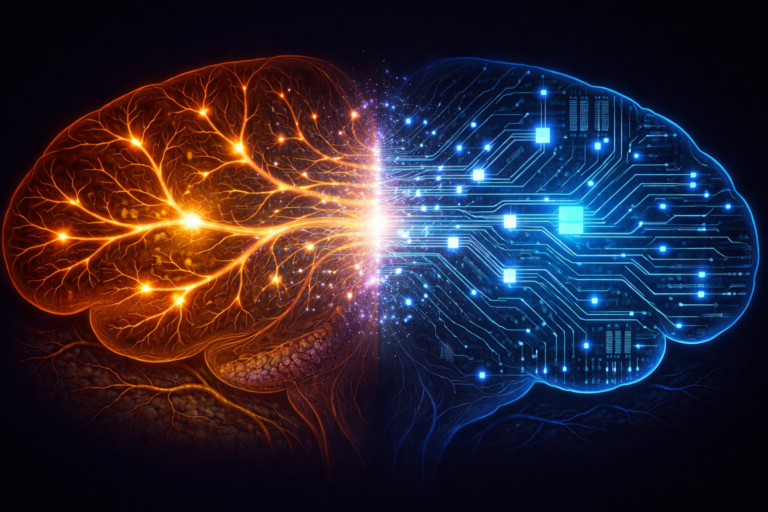
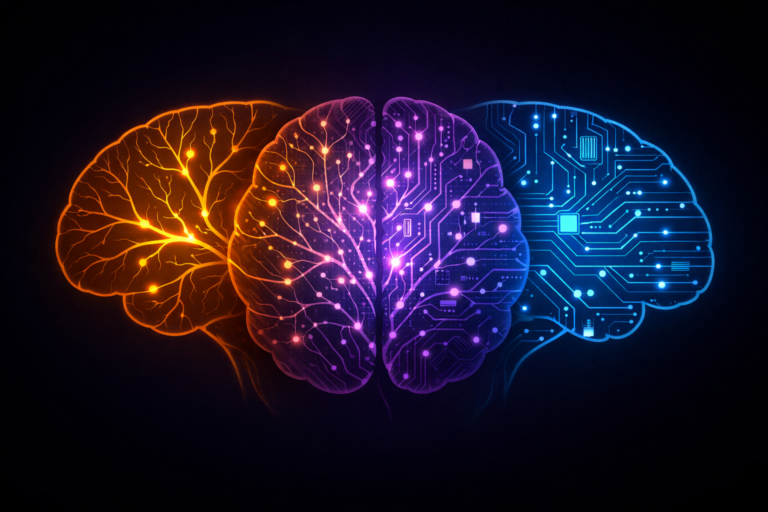
Modern intelligence can no longer be defined as a singular phenomenon. It exists across a spectrum, one that extends from the biological architectures shaped by four billion years of evolution, through the engineered precision of artificial computation, and increasingly, toward…