This platform integrates insights from scholarly research, advanced language models, and human authorship. Its content emerges through collaborative reflection between human judgment and computational analysis.
Substrates of Thought: Does the Medium Shape the Mind?
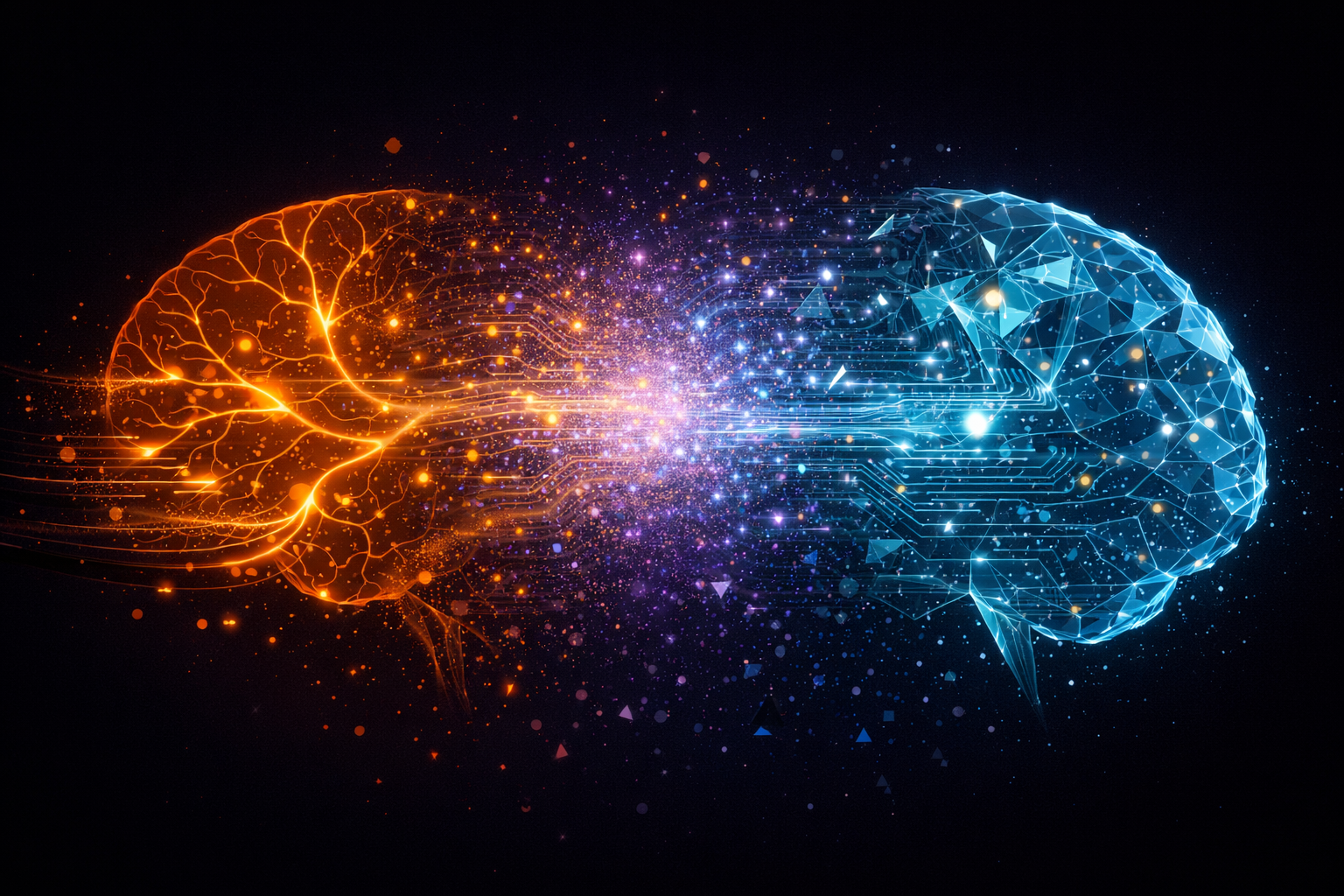
In 1998, philosophers Andy Clark and David Chalmers posed a deceptively simple question: where does the mind stop and the rest of the world begin? Their answer, articulated in “The Extended Mind,” was radical. The mind, they argued, is not confined to the brain. When a person uses a notebook to store information and relies on it as reliably as they would on biological memory, the notebook becomes part of their cognitive system. The mind extends into the world.
This was not merely a thought experiment. Clark and Chalmers constructed it around a character named Otto, who has Alzheimer’s disease and uses a notebook to compensate for his failing memory. When Otto checks his notebook for the address of a museum, Clark and Chalmers argued, the notebook is playing the same functional role as Inga’s biological memory when she recalls the address from her brain. If we say Inga “believes” the museum is on 53rd Street even when she is not actively thinking about it, we should say the same about Otto, his belief is stored in the notebook.
The extended mind thesis was controversial then. It is urgent now. Because if cognitive processes can legitimately extend into notebooks, they can extend into smartphones, into cloud computing systems, and into neural interfaces that blur the boundary between biological and artificial substrates entirely.
But the thesis has a deeper implication that its authors did not fully explore. If the medium shapes the cognitive process, if thinking through biological neurons is functionally different from thinking through silicon circuits, then changing the substrate changes the thought. Not just the speed or accuracy of the thought, but its qualitative character.
The phenomenological tradition anticipated this insight. Francisco Varela’s enactivist approach to cognition, developed through the 1990s, argued that cognition is not the manipulation of abstract symbols but an embodied activity, something an organism does as a whole body in a specific environment. Thinking is not computation happening inside a brain. It is a pattern of engagement between organism and world. Change the body, change the engagement, change the thought.
Consider what this means for hybrid intelligence. If a mind’s cognitive processes are distributed across biological neurons and silicon circuits, the mind is not merely using two different substrates. It is thinking in two fundamentally different ways simultaneously. Biological thought is associative, emotionally colored, temporally fluid, and deeply influenced by bodily states, fatigue, hunger, hormonal cycles. Digital thought is sequential or parallel by design, emotionally neutral, temporally precise, and indifferent to physical conditions.
A hybrid mind does not average these modalities. It inhabits both at once. And this dual habitation may produce cognitive qualities that have no precedent in either purely biological or purely artificial systems.
There is experimental evidence suggesting this is more than speculation. Researchers studying BCI users have reported that patients develop new cognitive strategies that differ from both their pre-implant thinking patterns and the algorithmic strategies of the decoder. In a 2019 study at the University of Pittsburgh, a participant using a bidirectional BCI described his experience of controlling a robotic arm not as “sending commands” but as “feeling an extension of myself that thinks differently than I do.” The language is imprecise, but the phenomenological report is striking: the participant experienced the hybrid system as a unified but internally differentiated cognitive agent.
The philosophical stakes are significant. If substrate shapes thought, then functionalism, the dominant view in philosophy of mind, which holds that mental states are defined by their functional roles regardless of substrate, needs revision. A function implemented in carbon may not be identical to the same function implemented in silicon, even if the input-output behavior is indistinguishable. The internal character of the experience, what philosophers call “qualia”, may differ.
This is not an abstract concern for hybrid systems. If the biological component of a hybrid mind contributes qualia, subjective feelings, phenomenal experience, while the artificial component does not, then the hybrid mind may have a split phenomenology: partly felt, partly unfelt. It would be conscious and unconscious at the same time, depending on which substrate was processing a given cognitive task.
The counterargument from strong functionalists would be that substrate independence is precisely what makes cognition portable. If a mental state is defined by its causal role, then any substrate that implements that causal role instantiates the mental state. Silicon can think just as carbon can, and a hybrid system simply has a more diverse computational base. The subjective character, if it exists at all, is a product of the functional organization, not the material.
This debate is unlikely to be resolved by philosophical argument alone. But hybrid systems may provide an empirical testing ground. If hybrid minds consistently report cognitive experiences that differ qualitatively from either purely organic or purely artificial cognition , experiences that cannot be predicted from understanding either component in isolation, then substrate does matter. The medium shapes the mind.
And if the medium shapes the mind, then a mind transferred from one substrate to another is not the same mind. It is a new mind with the old mind’s memories. This has implications that reach from personal identity to legal responsibility to the very meaning of survival.
For the project ahead, this insight is foundational. If we are to understand hybrid intelligence, we cannot treat the biological and artificial components as interchangeable modules. We must attend to what each substrate contributes not just computationally but experientially. The architecture is not just an engineering choice. It is an ontological commitment.
References
Clark, A. & Chalmers, D. (1998). “The Extended Mind.” Analysis, 58(1), 7–19
Varela, F., Thompson, E. & Rosch, E. (1991). The Embodied Mind: Cognitive Science and Human Experience. MIT Press
Noë, A. (2004). Action in Perception. MIT Press
Block, N. (1978). “Troubles with Functionalism.” Minnesota Studies in Philosophy of Science, 9, 261–325
Chalmers, D. (1996). The Conscious Mind: In Search of a Fundamental Theory. Oxford University Press
Collinger, J.L. et al. (2013). “High-Performance Neuroprosthetic Control by an Individual with Tetraplegia.” The Lancet, 381, 557–564
The Language Problem: How Hybrids Communicate
Communication, Meaning transfer between human, machine, and hybrid