This platform integrates insights from scholarly research, advanced language models, and human authorship. Its content emerges through collaborative reflection between human judgment and computational analysis.
Legal Personhood Beyond Biology
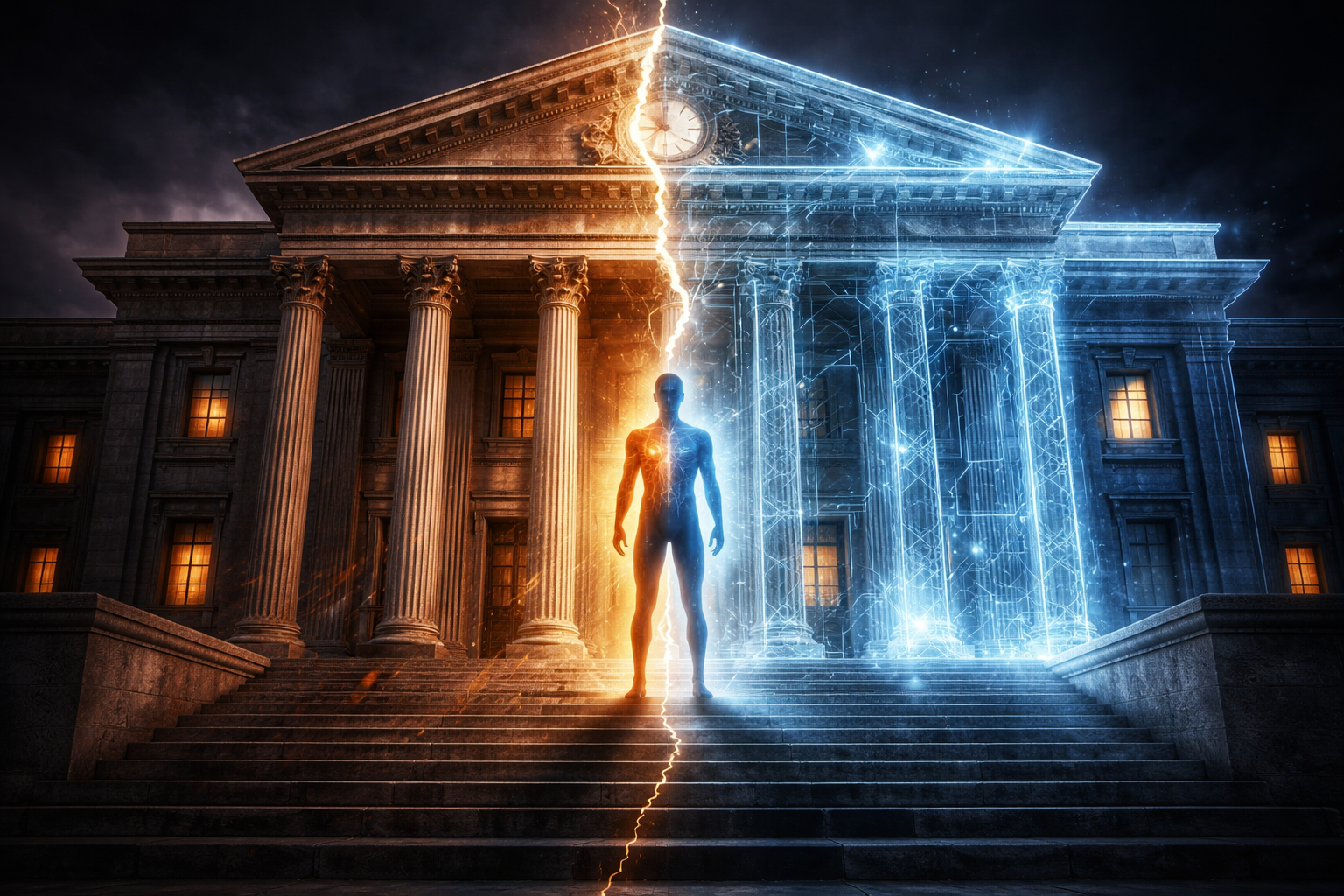
In 2017, the New Zealand parliament granted legal personhood to the Whanganui River. The river, a body of water, not a body of flesh, was recognized as an entity with rights, interests, and standing before the law. The decision was not a metaphor. The river can now sue and be sued. It has legal guardians who act on its behalf. Its health is a matter of enforceable legal obligation.
This was not without precedent. In 2008, Ecuador’s constitution recognized the rights of nature. In 2014, a New Zealand national park, Te Urewera, was granted legal personhood. India’s Uttarakhand High Court did the same for the Ganges and Yamuna rivers in 2017, though the Indian Supreme Court later stayed the decision on practical grounds.
These cases matter for hybrid intelligence because they demonstrate something that legal theorists have long understood but rarely confronted directly: legal personhood is not a description of biological reality. It is a legal fiction, deliberately constructed to serve specific social purposes.
The history is instructive. Roman law distinguished between personae and res, persons and things. Slaves were res, despite being biologically human. Women had limited personhood in many jurisdictions well into the twentieth century. Corporations, meanwhile, have enjoyed legal personhood since at least the fifteenth century. The Dartmouth College v. Woodward decision in 1819 established that a corporation possesses rights independent of its members. Citizens United v. FEC in 2010 extended certain free speech protections to corporations on personhood grounds.
The pattern is clear: legal personhood expands when social and economic pressures demand it. The question is not whether the entity “really” is a person in some metaphysical sense but whether treating it as a person serves the legal system’s goals of protecting rights, assigning responsibilities, and enabling transactions.
Hybrid intelligence will generate exactly this kind of pressure. When a hybrid entity enters into a contract, who is bound? When it creates intellectual property, who owns it? When it causes harm, who is liable? Current legal categories, natural person and juridical person, cannot accommodate an entity that is partly biological and partly artificial, partly autonomous and partly designed.
Some legal scholars have proposed a third category. Shyamanta Asokan and others have suggested “electronic personhood” for autonomous AI systems. The European Parliament considered and rejected a version of this proposal in 2017. Critics argued that electronic personhood would create a “responsibility gap”, manufacturers and programmers could deflect liability onto the AI entity itself, which may lack assets or the capacity for genuine accountability.
For hybrid entities, the challenge is more nuanced. Unlike pure AI systems, a hybrid mind includes a biological component that may have pre-existing legal personhood as a human being. Does the hybrid entity inherit that personhood? Or does the integration of artificial components create a new entity that must establish its own legal standing?
Consider a concrete scenario. A person with a neural implant that significantly enhances their cognitive capabilities commits a crime. The defense argues that the criminal intent originated in the artificial component’s optimization process, not in the biological component’s conscious will. The prosecution argues that the person chose to integrate the implant and bears responsibility for its outputs. The court must decide: is this one person or two? Is the implant a tool or a co-agent?
The EU’s Artificial Intelligence Act, which entered force in 2024, begins to address some of these questions by classifying AI systems by risk level and imposing corresponding obligations. But it was designed for AI as a product, not as a component of a living cognitive system. Its categories assume a clear boundary between the AI and its user, precisely the boundary that hybrid intelligence dissolves.
What is needed is not simply a new legal category but a new legal paradigm, one that recognizes personhood as a spectrum rather than a binary, with corresponding spectra of rights and responsibilities. A fully autonomous hybrid entity might bear full legal responsibility for its actions. A partially integrated system might share responsibility between its biological and artificial components, with allocation determined by the degree of integration and the nature of the action.
This is not as radical as it sounds. Existing legal systems already operate with graduated concepts of responsibility: diminished capacity, contributory negligence, vicarious liability. The challenge is extending these gradations to entities whose internal architecture is genuinely novel.
The alternative, refusing to develop new legal frameworks until hybrid entities force the issue through crisis, is the path we are currently on. History suggests this is how legal innovation usually happens: not through foresight but through the messy aftermath of events that existing law cannot handle. The Whanganui River got its personhood after 140 years of legal struggle by the Māori people. Hybrid entities should not have to wait as long.
References
Kurki, V. (2019). A Theory of Legal Personhood. Oxford University Press
Naffine, N. (2009). Law’s Meaning of Life: Philosophy, Religion, Darwin and the Legal Person. Hart Publishing
European Parliament (2017). Resolution on Civil Law Rules on Robotics, 2015/2103(INL)
EU Artificial Intelligence Act (2024). Regulation (EU) 2024/1689
Dartmouth College v. Woodward, 17 U.S. (4 Wheat.) 518 (1819)
Te Awa Tupua (Whanganui River Claims Settlement) Act 2017 (New Zealand)
The Ethics of Enhancement vs. Replacement
Bioethics, Where does enhancement end and replacement begin?