This platform integrates insights from scholarly research, advanced language models, and human authorship. Its content emerges through collaborative reflection between human judgment and computational analysis.
The Language Problem: How Hybrids Communicate
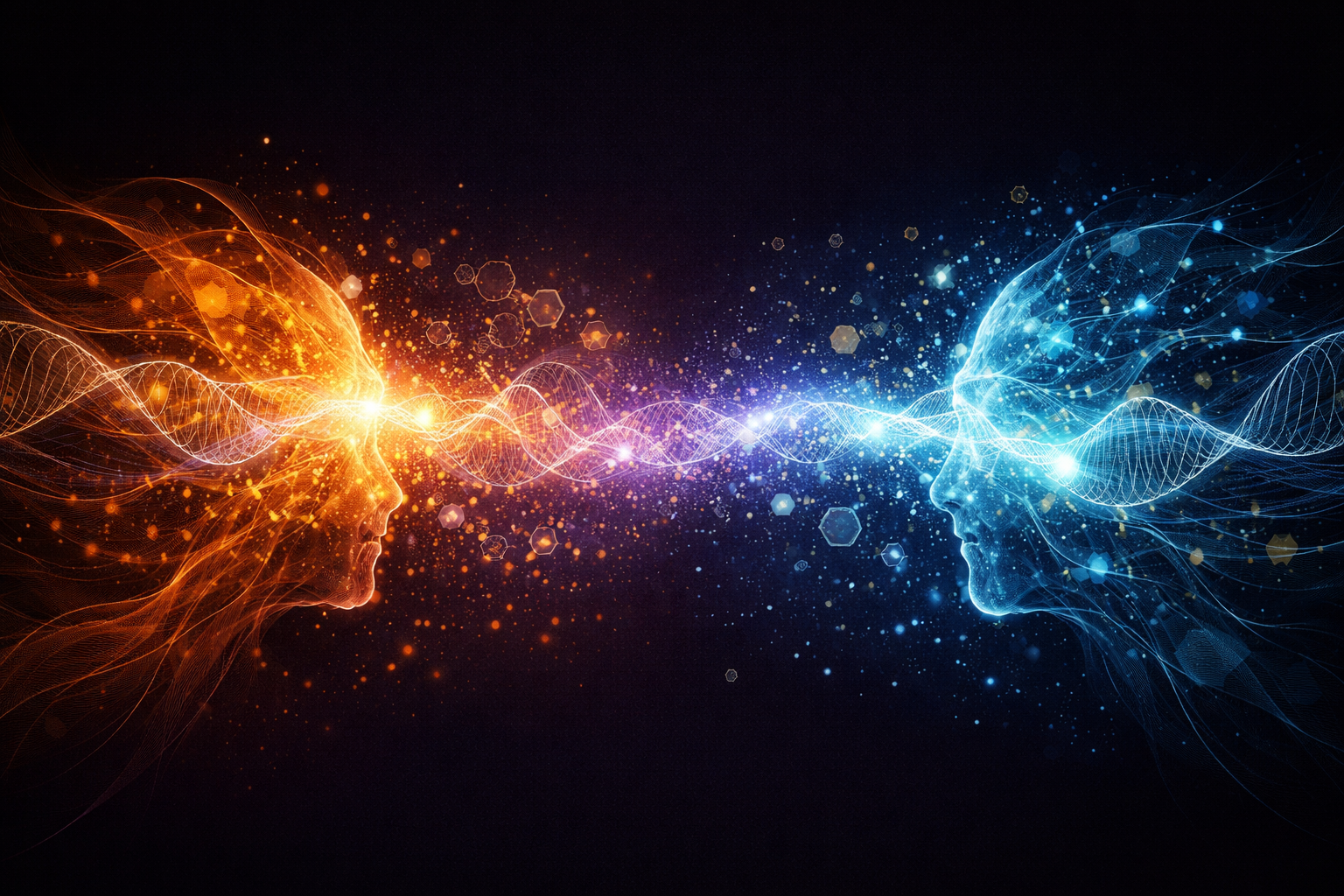
Ludwig Wittgenstein argued that the limits of my language are the limits of my world. If he was right, then hybrid intelligence faces a peculiar predicament: it inhabits multiple worlds simultaneously, each with its own language, and must somehow construct meaning across the boundaries.
The problem is not merely technical. Natural language, the medium of human thought and communication, is inherently ambiguous, context-dependent, and saturated with connotation. When a human says “I understand,” the word carries emotional resonance, social commitment, and phenomenological weight. When a language model generates the same phrase, it produces a statistically probable sequence of tokens. The surface form is identical. The underlying reality is categorically different.
For hybrid systems, this creates what we might call the “translation gap.” The biological component of a hybrid mind processes meaning through embodied experience, memories, emotions, sensory associations. The word “rain” evokes not just a meteorological phenomenon but the smell of wet earth, the sound on a roof, a childhood afternoon. The artificial component processes the same word through vector representations in high-dimensional space, mathematical relationships to other words, statistical patterns derived from training data. Both are forms of meaning. Neither is reducible to the other.
This is not a new problem in philosophy. Willard Van Orman Quine’s thought experiment of “radical translation”, imagining an anthropologist trying to translate a completely unknown language with no shared reference points, illustrates the fundamental indeterminacy of meaning. When a native speaker points at a rabbit and says “gavagai,” does the word refer to the rabbit, to rabbit-hood, to an undetached rabbit part, to a temporal slice of rabbit? Translation, Quine argued, is always underdetermined by evidence.
Within a hybrid mind, the problem is internalized. The biological component generates meaning in one “language”, a language of sensation, association, and felt significance. The artificial component operates in another, a language of vectors, weights, and probabilistic relationships. The interface between them must translate continuously, and every translation involves loss.
Current AI systems approach this gap through natural language processing, treating human language as the common medium. But this is a compromise, not a solution. When a BCI translates neural firing patterns into machine-readable signals, it reduces a rich, multidimensional biological process to a narrow data stream. The neural activity associated with the intention to move a hand involves thousands of neurons firing in complex temporal patterns, modulated by emotional state, attention, fatigue, and countless other factors. The decoder extracts a simplified signal: direction, velocity, grip force. The translation works, but at the cost of most of the original information.
What would a genuine hybrid language look like? It would need to preserve the strengths of both modalities: the associative richness and emotional depth of biological meaning-making, and the precision and scalability of computational representation. Some researchers have proposed “neuro-symbolic” architectures that combine neural network pattern recognition with symbolic logical reasoning. Others have explored “grounded language models” that connect linguistic representations to sensory and motor experience.
But these remain human-designed bridges between human-defined categories. A truly hybrid language might emerge spontaneously from the interaction of biological and artificial components, a communication system that was neither natural language nor programming language but something without precedent. There is a suggestive parallel in the phenomenon of “creolization”: when speakers of mutually unintelligible languages are forced into sustained contact, new languages emerge that are not simply mixtures of the originals but exhibit novel grammatical structures that neither parent language possessed.
The implications for the internal experience of hybrid minds are profound. If language shapes thought, as the Sapir-Whorf hypothesis suggests, at least in its weaker form, then a hybrid mind thinking in a hybrid language would have cognitive experiences inaccessible to either purely human or purely artificial systems. It would literally think thoughts that no human and no machine could think alone.
There is a lonelier implication as well. A mind that thinks in a language no one else speaks is, in a very real sense, isolated. Even if it can translate its thoughts into human language or machine code, the translation always loses something. The hybrid mind would carry a permanent residue of incommunicable experience, thoughts that can be thought but never fully shared.
Wittgenstein also wrote that whereof one cannot speak, thereof one must be silent. But hybrid intelligence may eventually demonstrate that silence is not the only alternative. Perhaps there are modes of communication we have not yet imagined, modes that a mind distributed between code and cell will be the first to discover.
References
Wittgenstein, L. (1922). Tractatus Logico-Philosophicus. Routledge
Quine, W.V.O. (1960). Word and Object. MIT Press
Whorf, B.L. (1956). Language, Thought, and Reality. MIT Press
Bickerton, D. (1981). Roots of Language. Karoma Publishers
Garcez, A. et al. (2019). “Neural-Symbolic Computing: An Effective Methodology for Principled Integration of Machine Learning and Reasoning.” FLAP, 6(4), 611–632
Bisk, Y. et al. (2020). “Experience Grounds Language.” Proceedings of EMNLP
Memory, Identity, and Continuity
Philosophy, Who is “I” in a changing system?