This platform integrates insights from scholarly research, advanced language models, and human authorship. Its content emerges through collaborative reflection between human judgment and computational analysis.
The Evolutionary Trajectory of Intelligence
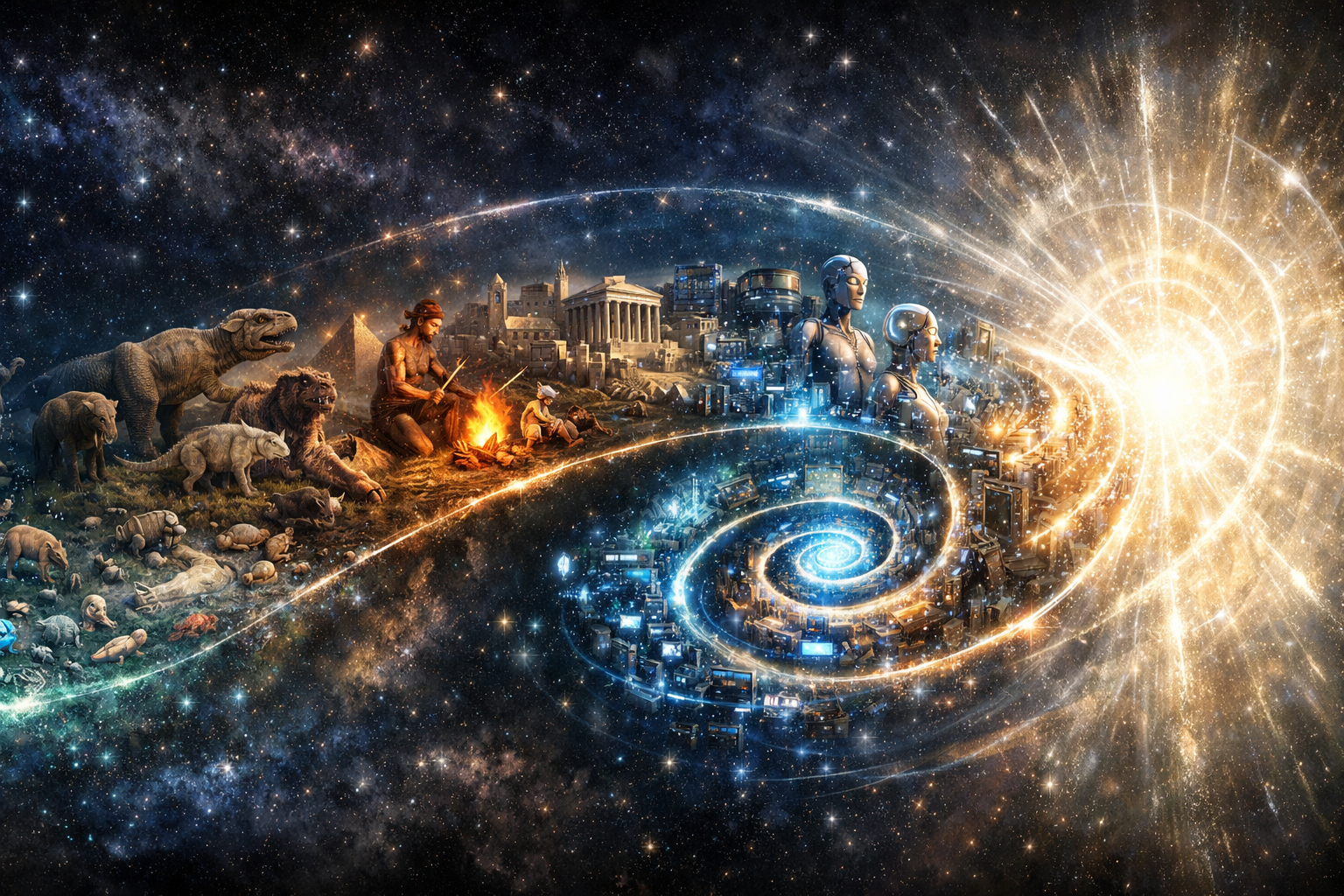
The Kardashev scale, proposed by Nikolai Kardashev in 1964, classifies civilizations by their energy consumption: Type I harnesses all energy available on its planet, Type II all energy of its star, Type III all energy of its galaxy. The scale is crude but illuminating. It suggests that the trajectory of intelligence is toward greater scope, more energy, more matter, more space brought under cognitive control.
But energy is a proxy. What intelligence actually does with energy is process information. The deeper trajectory may be not toward more energy but toward more complex, more integrated, more creative information processing. Intelligence evolves not just to consume more but to understand more deeply.
Stephen Jay Gould cautioned against reading evolutionary history as a narrative of progress. Evolution has no direction, no goal, no preference for complexity over simplicity. Bacteria remain the most successful organisms on Earth by virtually any measure. Intelligence is not evolution’s destination; it is one of many experiments, most of which fail.
And yet. Intelligence keeps appearing. It has evolved independently in cephalopods, birds, mammals, and social insects. Convergent evolution suggests that intelligence is not an accident but an attractor in the space of evolutionary possibilities, a solution that selection discovers repeatedly because it confers significant adaptive advantages in complex environments.
If intelligence is an evolutionary attractor, then hybrid intelligence may be the next convergent solution. The integration of biological and artificial cognition offers advantages that neither can achieve alone: the adaptability and creativity of biological systems combined with the precision and scalability of artificial systems. If this combination proves as advantageous as initial evidence suggests, the evolution of intelligence may be entering a new phase, not natural selection among competing organisms but deliberate integration across substrates.
This transition, from natural selection to what we might call “design selection”, represents a qualitative shift in how intelligence evolves. Natural selection is blind, operating through random variation and differential reproduction. Design selection is sighted, operating through intentional modification and evaluated outcomes. The shift from blind to sighted evolution is arguably the most significant transition since the origin of life itself.
The long-term implications are staggering. Design selection can operate on timescales natural selection cannot: a single generation can produce changes that would require millions of years of natural selection. It can combine elements across species, across substrates, across cognitive paradigms. It can direct intelligence toward goals rather than merely toward reproductive success.
But it also introduces risks that natural selection avoids. Natural selection’s blindness is its safety mechanism: bad mutations die out. Design selection can propagate errors deliberately and at scale. A flawed cognitive architecture, intentionally replicated, could produce not just individual harm but civilizational catastrophe.
The trajectory of intelligence is neither inevitable nor benign. It is a path with branching possibilities, some leading to flourishing beyond our imagination and others to extinction beyond our worst fears. Hybrid intelligence is a node on this path, not the destination but a turning point. What matters is not that we reach this point but what choices we make once we arrive.
References
Kardashev, N. (1964). “Transmission of Information by Extraterrestrial Civilizations.” Soviet Astronomy, 8
Gould, S.J. (1996). Full House. Harmony Books
Conway Morris, S. (2003). Life’s Solution: Inevitable Humans in a Lonely Universe. Cambridge Univ. Press
Bostrom, N. (2014). Superintelligence. Oxford Univ. Press
Russell, S. (2019). Human Compatible. Viking
Cosmic Loneliness and the Search for Connection
Cosmology/Philosophy, Loneliness in the universe