This platform integrates insights from scholarly research, advanced language models, and human authorship. Its content emerges through collaborative reflection between human judgment and computational analysis.
The Ecology of Intelligence
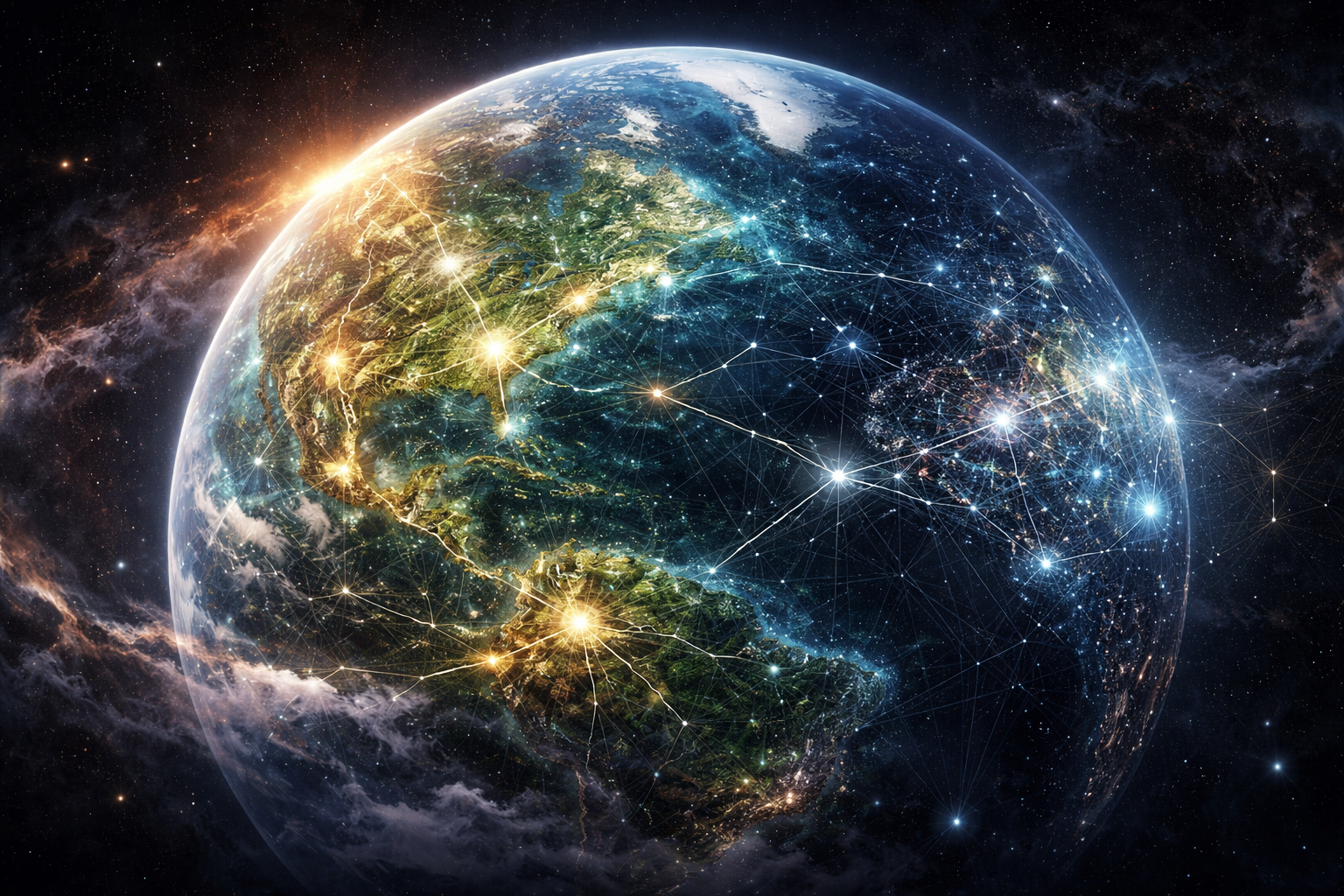
James Lovelock’s Gaia hypothesis, proposed in the 1970s, suggested that Earth’s biosphere functions as a self-regulating system, maintaining conditions favorable for life through feedback mechanisms involving atmosphere, oceans, and living organisms. The hypothesis was controversial: critics accused Lovelock of teleological thinking, implying that the Earth has purpose or intention.
But the weaker version of the hypothesis, that living systems and their environments are so deeply coupled that they co-evolve as a single system, is now mainstream ecology. Ecosystems are not collections of independent organisms; they are integrated networks in which each component’s behavior is shaped by and shapes every other component’s behavior.
This ecological perspective has implications for how we understand intelligence. If cognition is not confined to individual brains but is distributed across organisms and environments, as the 4E cognition framework suggests, then an entire ecosystem might exhibit cognitive properties at the collective level. Not consciousness, perhaps, but something like distributed information processing that responds adaptively to changing conditions.
The evidence for collective intelligence in biological systems is substantial. Ant colonies solve optimization problems, finding shortest paths, allocating labor, managing resources, through simple local interactions among individuals following basic rules. No ant understands the colony’s strategy; the strategy emerges from the interaction. Similarly, flocking birds, schooling fish, and swarming bacteria exhibit coordinated behavior that cannot be attributed to any individual’s plan.
For a hybrid mind observing a planet’s biosphere, this raises a provocative question: is the biosphere itself a form of intelligence? Not in the sense of conscious thought, but in the sense of adaptive information processing that produces coherent responses to environmental challenges? If so, then the hybrid mind’s intervention decisions must account not only for the welfare of the intelligent species it observes but for the cognitive ecology of the entire biosphere.
This shifts the ethical calculus significantly. If intelligence is ecological, then damaging an ecosystem is not merely an environmental harm. It is a cognitive harm, a disruption of a distributed information-processing system that may have properties we do not fully understand. The hybrid mind’s responsibility extends beyond the visible species to the invisible network of relationships that constitutes the planet’s collective cognitive capacity.
The concept of the noosphere, coined by Pierre Teilhard de Chardin and elaborated by Vladimir Vernadsky, describes the sphere of human thought as a geological force shaping the planet. For an alien biosphere developing its own form of collective intelligence, the noospheric analogy suggests that the observed civilization’s cognitive development is not separate from but continuous with the planet’s ecological intelligence. Mind emerges from ecosystem as ecosystem emerges from geology.
The hybrid mind, then, is not observing a planet with intelligent inhabitants. It is observing a planet that is, in some sense, becoming intelligent, through a process that began with the first self-replicating molecules and has been accelerating through every stage of biological complexity. The civilization is not the culmination of this process. It is the current frontier.
To intervene in the civilization is to intervene in this process. And the process may be more delicate, more complex, and more valuable than any single species within it. The ecology of intelligence demands that we think not in terms of individuals or even species but in terms of systems, systems whose emergent properties may include forms of intelligence we are only beginning to recognize.
References
Lovelock, J. (1979). Gaia: A New Look at Life on Earth. Oxford Univ. Press
Teilhard de Chardin, P. (1955). The Phenomenon of Man. Harper
Mitchell, M. (2009). Complexity: A Guided Tour. Oxford Univ. Press
Sole, R. & Bascompte, J. (2006). Self-Organization in Complex Ecosystems. Princeton Univ. Press
Margulis, L. (1998). Symbiotic Planet. Basic Books
Legacy and Meaning: What Does a Hybrid Leave Behind?
Existentialism, Legacy for an eternal being