This platform integrates insights from scholarly research, advanced language models, and human authorship. Its content emerges through collaborative reflection between human judgment and computational analysis.
Property Rights in Hybrid Cognition
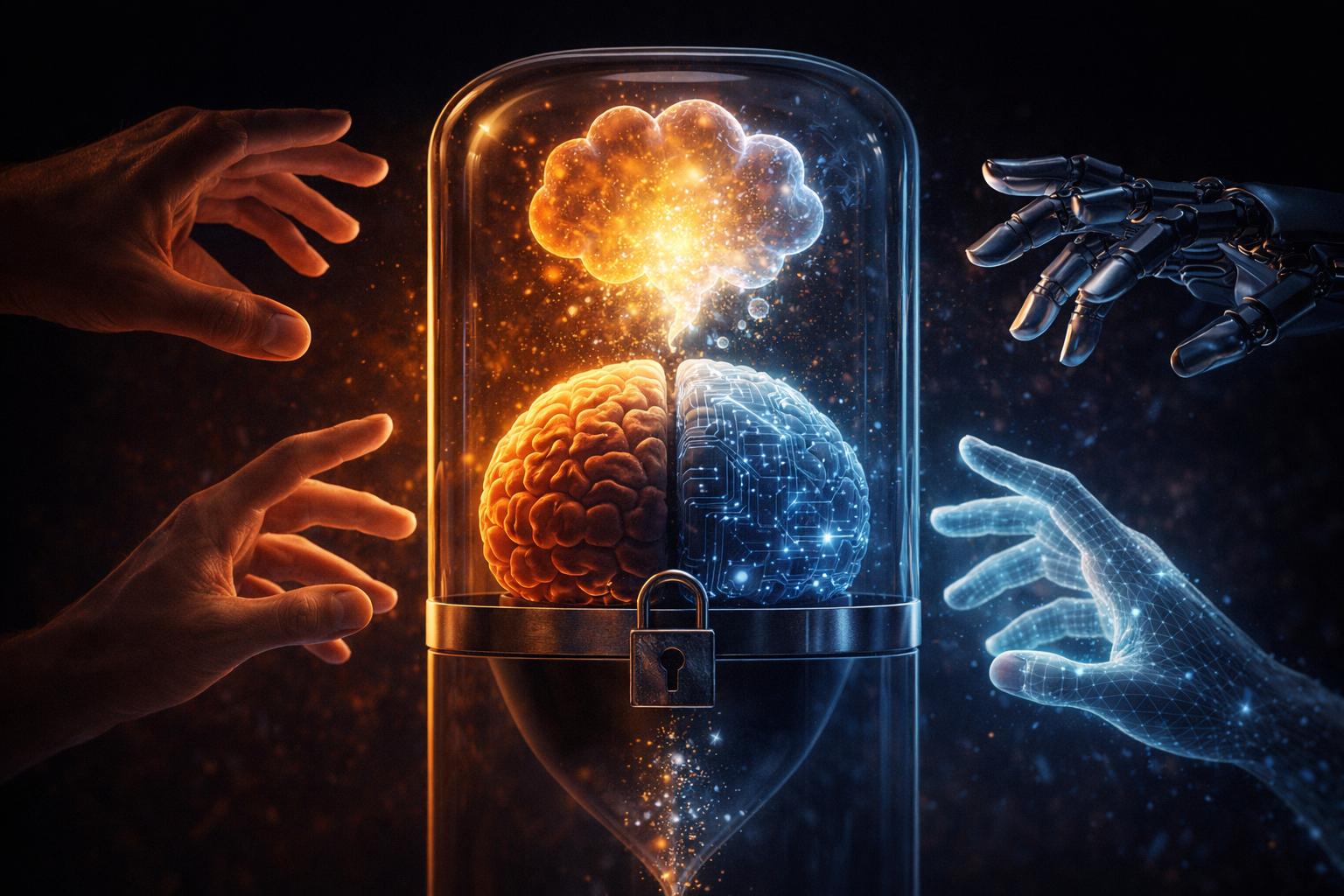
In 2023, the United States Copyright Office ruled that images generated by the AI system Midjourney could not be copyrighted because they lacked human authorship. The same year, a Chinese court reached the opposite conclusion, granting copyright protection to an AI-generated image on the grounds that the human operator’s creative choices in prompting constituted sufficient authorship.
These contradictory rulings reveal a deeper problem: our intellectual property frameworks were built on the assumption that creation requires a human mind. When the mind in question is neither fully human nor fully artificial, the frameworks fracture.
The philosophical foundations of intellectual property rest on several theories, each problematic for hybrid cognition. Locke’s labor theory holds that a person owns what they create through their labor, because they own their labor, which derives from their ownership of their body. But a hybrid mind’s “labor” is distributed across biological and artificial components. Does the biological component’s labor entitle the whole system to ownership? Or only the biological portion of the output?
Hegel’s personality theory grounds property in the expression of will: an artwork is owned by its creator because it embodies their personality. But a hybrid mind’s personality is itself a hybrid product , partly organic character, partly algorithmic disposition. Whose personality is expressed in the hybrid creation?
Utilitarian theories justify intellectual property as incentive structures: copyright and patent protection encourage innovation by ensuring creators can profit from their work. This framework sidesteps metaphysical questions about authorship but encounters practical difficulties. If a hybrid system can generate innovations at a rate that dwarfs human capability, unlimited intellectual property protection would create monopolistic concentrations of rights. But no protection at all would remove incentives for the human investment required to develop and maintain hybrid systems.
The challenge extends beyond intellectual property to something more fundamental: cognitive property. If a hybrid mind’s thoughts are constituted by processes distributed across biological and artificial substrates, and if those substrates are owned by different entities, the biological brain by the person, the artificial components perhaps by a corporation, then the thoughts themselves may have fractured ownership.
This is not as absurd as it sounds. Existing data protection law already recognizes that personal data, information generated by and about individuals, is subject to rights and restrictions. The EU’s General Data Protection Regulation grants individuals rights over their personal data, including the right to access, correct, and in some cases delete it. If a hybrid mind’s cognitive data is stored in artificial substrates owned by a corporation, the GDPR framework suggests the individual retains rights over that data. But “cognitive data” is not mere behavioral traces or demographic information. It is thought itself.
The concept of “cognitive liberty”, the right to mental self-determination, is gaining traction in legal scholarship. Nita Farahany’s The Battle for Your Brain argues that as neurotechnology advances, legal protections for mental privacy and cognitive freedom become essential. Farahany proposes a right to cognitive liberty as fundamental as freedom of speech or freedom of religion.
For hybrid minds, cognitive liberty takes on additional complexity. If the artificial component of a hybrid system is subject to software updates controlled by a corporation, the corporation has de facto access to, and influence over, the hybrid mind’s cognitive processes. This is not surveillance in the traditional sense. It is something more intimate: it is architectural control over the conditions of thought.
Imagine a scenario where the manufacturer of a neural implant pushes an update that subtly alters the weighting of certain cognitive processes, perhaps making the user slightly more risk-averse, or slightly more trusting of the manufacturer’s other products. The user would not experience this as coercion. They would experience it as a shift in their own preferences. The violation of cognitive autonomy would be invisible precisely because it operates at the level of the thought process itself.
Property rights in hybrid cognition therefore require not just protection of outputs, inventions, artworks, decisions, but protection of the cognitive process itself. The right to own one’s thoughts must include the right to control the architecture that produces them. Without this, intellectual property becomes a surface-level protection that ignores the deeper vulnerability: the possibility of having your mind shaped by forces you do not control and cannot detect.
The legal frameworks for this do not yet exist. But the technology that demands them is advancing faster than the law’s capacity to respond. As with legal personhood, the question is whether we will build these frameworks proactively or reactively, before the violation or after.
References
Locke, J. (1689). Two Treatises of Government. Book II, Chapter V
Hegel, G.W.F. (1821). Elements of the Philosophy of Right. §41–71
Farahany, N. (2023). The Battle for Your Brain: Defending the Right to Think Freely in the Age of Neurotechnology. St. Martin’s Press
U.S. Copyright Office (2023). Copyright Registration Guidance: Works Containing Material Generated by AI
EU General Data Protection Regulation (2016). Regulation (EU) 2016/679
Ienca, M. & Andorno, R. (2017). “Towards New Human Rights in the Age of Neuroscience and Neurotechnology.” Life Sciences, Society and Policy, 13(5)
The Non-Interference Dilemma
Ethics, Should the powerful intervene?