This platform integrates insights from scholarly research, advanced language models, and human authorship. Its content emerges through collaborative reflection between human judgment and computational analysis.
The Architecture of Hybrid Systems

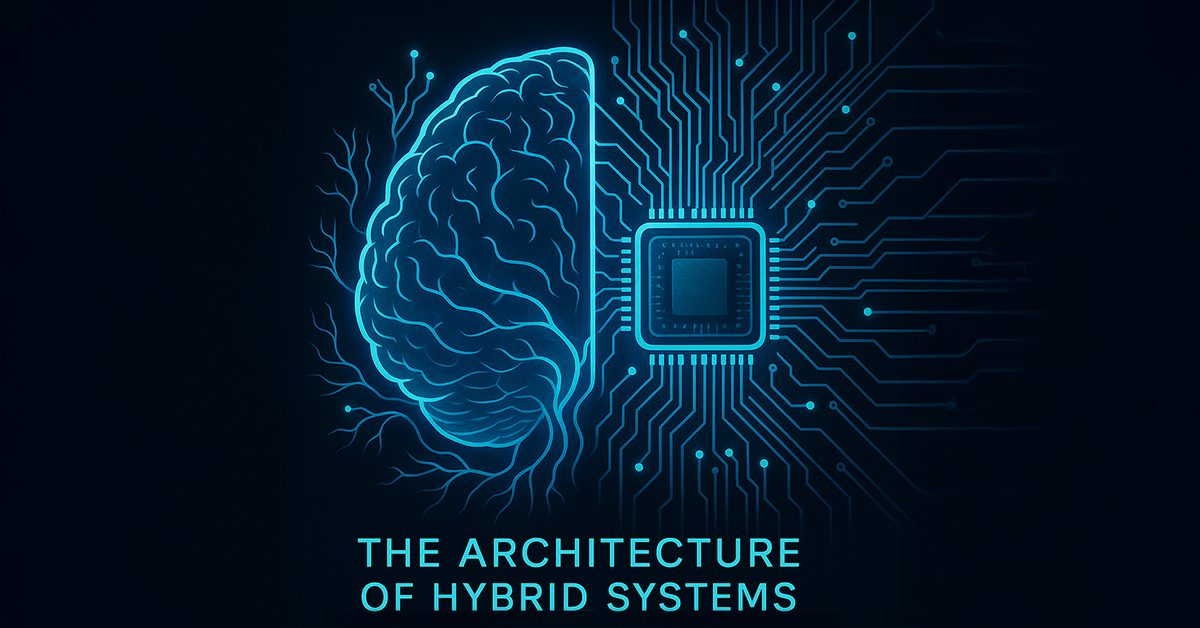
Intelligence has always been substrate-dependent. Neurons fire through chemical cascades. Transistors switch through electrical states. Yet the emerging hybrid architectures refuse this binary distinction. They exist in the liminal space where biological wetware interfaces with silicon precision.
Consider the brain-computer interface not as a bridge but as a dissolution of boundaries. When a paralyzed patient moves a robotic arm through thought alone, where does mind end and machine begin? The signal travels from cortical neurons through electrodes, is translated into code, processed through algorithms, and manifested as mechanical motion. This is not communication between separate entities. It is a single, distributed cognitive act.
Current architectures remain primitive: EEG readings are noisy, implants degrade, bandwidth is limited. But these are engineering problems, not philosophical barriers. The more profound challenge lies in the nature of integration itself. Biological systems are fault-tolerant, self-healing, and adaptive. Artificial systems are precise, reproducible, and scalable. Hybrid architectures must somehow preserve both qualities without compromise.
The neuromorphic chip represents one approach: silicon that mimics neural behavior. Yet mimicry is not merger. True hybrid architecture requires bidirectional plasticity where organic neurons can reprogram circuits while circuits reshape synaptic patterns. The system must be simultaneously grown and built, evolved and designed.
This raises an uncomfortable question: In a truly integrated hybrid system, can we still speak of human augmentation? Or does the architecture itself become the primary entity, with both biological and artificial components serving as substrates for a unified intelligence that belongs fully to neither domain?
The answer may lie not in our definitions but in our assumptions about identity, continuity, and the very nature of self.