This platform integrates insights from scholarly research, advanced language models, and human authorship. Its content emerges through collaborative reflection between human judgment and computational analysis.
Directed Evolution vs. Natural Selection
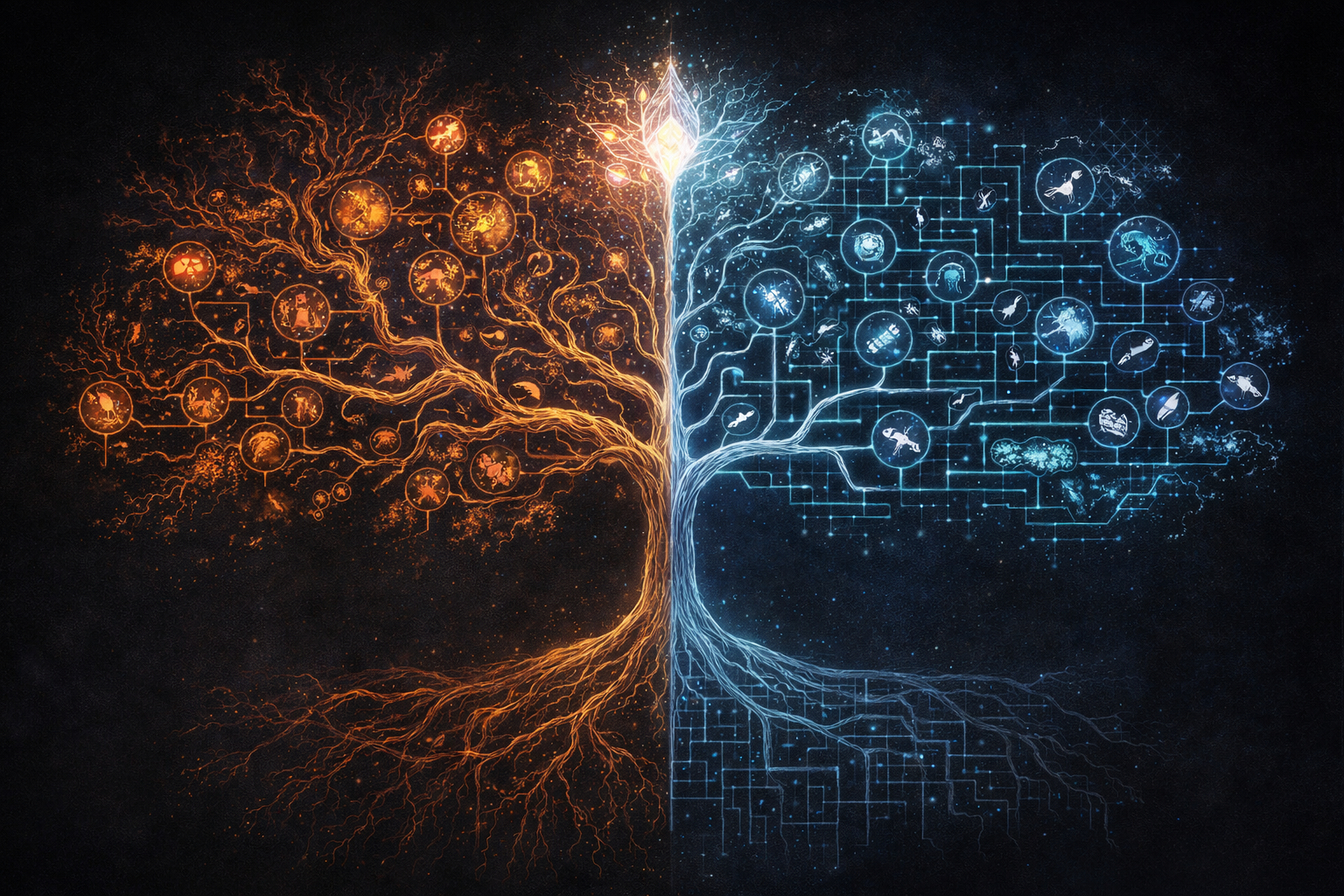
Richard Lenski’s Long-Term Evolution Experiment, begun in 1988, has tracked twelve populations of E. coli bacteria through over 75,000 generations. The experiment has documented evolution in real time: mutations arising, spreading through populations, producing novel metabolic capabilities that the ancestral bacteria lacked. One population famously evolved the ability to metabolize citrate, a capacity that had been absent in E. coli for millions of years.
Lenski’s experiment is powerful because it is observation, not intervention. The bacteria evolve under controlled conditions, but the mutations are random and the selection is natural. The experimenter sets the environment; evolution does the rest.
CRISPR-Cas9, the gene-editing technology that earned Jennifer Doudna and Emmanuelle Charpentier the 2020 Nobel Prize, represents the opposite approach: directed modification of genomes with surgical precision. CRISPR allows researchers to insert, delete, or modify specific genes in virtually any organism. The technology has been used to create disease-resistant crops, modify mosquitoes to reduce malaria transmission, and treat genetic disorders in humans.
The distinction between natural selection and directed evolution maps onto the hybrid mind’s dilemma. Natural selection is blind, wasteful, and slow, but it is autonomous. It produces outcomes that no designer anticipated, including outcomes that are exquisitely adapted to conditions no designer could have foreseen. Directed evolution is efficient, purposeful, and fast, but it reflects the designer’s values and the designer’s limitations.
The concept of “nature” carries ideological weight that complicates the analysis. The naturalistic fallacy, the inference that what is natural is therefore good, is logically invalid but culturally powerful. Ecosystems are not harmonious; they are sites of continuous competition, predation, parasitism, and extinction. Natural selection does not optimize for well-being; it optimizes for reproductive success, which can involve immense suffering.
A hybrid mind observing a civilization in the early stages of evolution might be tempted to accelerate the process, to nudge mutations in productive directions, eliminate particularly destructive pathogens, or introduce environmental conditions that favor the development of intelligence. The utilitarian argument is straightforward: millennia of suffering could be prevented by a few well-placed interventions.
But the argument against acceleration is equally powerful. Evolution’s blindness is also its creativity. By exploring vast possibility spaces without the constraints of foresight, natural selection discovers solutions that no designer would have conceived. A directed evolutionary path, however well-intentioned, narrows the space of possibilities. The civilization that results would be optimized for the hybrid mind’s conception of desirable outcomes, not for outcomes that the civilization itself might have discovered given time.
There is also the question of authenticity. A civilization that develops through its own evolutionary pressures owns its history. A civilization whose development was shaped by an external intelligence is, in a real sense, someone else’s project. The difference may be invisible to the civilization itself, they would never know, but it matters to the hybrid mind’s integrity and to the philosophical coherence of the project.
The tension cannot be resolved by choosing one side. Both natural selection and directed evolution have virtues and vices. Perhaps the most defensible position is the one that preserves the widest range of future options: do not intervene in ways that foreclose possibilities, but consider intervention when non-intervention would itself foreclose possibilities, when extinction, not suboptimal development, is the alternative.
References
Lenski, R. (2017). “Experimental Evolution and the Dynamics of Adaptation.” PNAS, 114(14)
Doudna, J. & Sternberg, S. (2017). A Crack in Creation. Houghton Mifflin
Gould, S.J. (1989). Wonderful Life. Norton
Kauffman, S. (1995). At Home in the Universe. Oxford Univ. Press
Sandler, R. (2012). The Ethics of Species. Cambridge Univ. Press
Communication Across Cognitive Chasms
Communication, Meaning without shared reference