This platform integrates insights from scholarly research, advanced language models, and human authorship. Its content emerges through collaborative reflection between human judgment and computational analysis.
Dreams, Creativity, and the Unconscious in Hybrid Systems
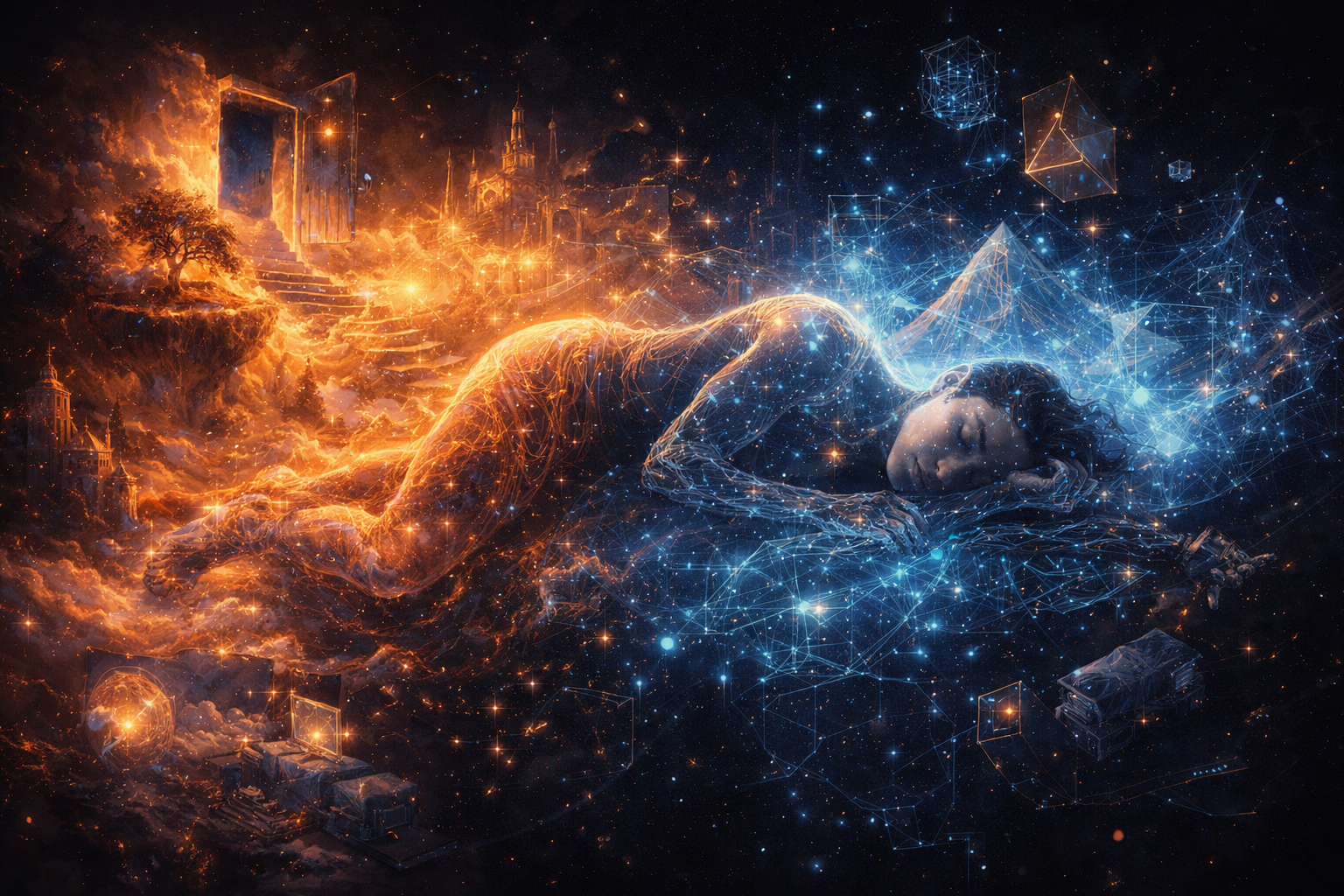
Freud called dreams the royal road to the unconscious. While many specifics of Freudian dream theory have been abandoned, the core insight endures: the dreaming mind engages in cognitive processes that are qualitatively different from waking thought. Dreams are associative, symbolic, emotionally saturated, and largely unconstrained by logic or physical law.
Contemporary neuroscience confirms that dreaming serves essential cognitive functions. The activation-synthesis hypothesis, proposed by Allan Hobson and Robert McCarley, suggests that dreams arise from the brain’s attempt to make sense of random neural activation during REM sleep. More recent research has demonstrated that sleep consolidates memories, strengthens useful neural connections, and prunes irrelevant ones. Dreams may be the subjective experience of this maintenance process.
Creativity research has long noted the connection between dreaming and innovation. August Kekulé reportedly discovered the ring structure of benzene after dreaming of a snake seizing its own tail. Elias Howe solved the problem of the sewing machine needle through a dream. While these anecdotes may be apocryphal, experimental evidence confirms that REM sleep enhances creative problem-solving by facilitating remote associations, connections between concepts that waking cognition keeps separate.
For hybrid intelligence, the question of dreams is not metaphorical. If the biological component of a hybrid mind sleeps, and biological neural tissue requires sleep for maintenance, it presumably dreams. But what happens when a dreaming biological component is coupled with an artificial component that does not sleep? Does the artificial component observe the dreams? Interpret them? Influence them?
The generative adversarial network (GAN) in machine learning offers a suggestive analogy. A GAN consists of two neural networks: a generator that creates outputs and a discriminator that evaluates them. The interaction between generation and evaluation produces outputs of increasing sophistication. In a hybrid mind, the biological unconscious might function as a generator, producing dreams, associations, creative leaps, while the artificial component functions as a discriminator, evaluating and refining these outputs.
The result might be a creative process of unprecedented power: the unconstrained generativity of biological dreaming filtered through the analytical precision of artificial evaluation. The hybrid mind would dream, but its dreams would be sharper, more purposeful, more likely to yield genuine insight.
But there is a counterargument. The value of dreams and unconscious processes may lie precisely in their freedom from evaluation. The unconscious is creative because it is uncensored. If the artificial component monitors and shapes the dreaming process, it may impose the very constraints that dreaming exists to escape. The hybrid mind’s dreams might be more efficient but less wild, optimized for utility at the cost of the radical novelty that makes dreaming valuable.
The unconscious in hybrid systems raises a final philosophical question: if consciousness is the integration of information, and the unconscious is precisely what is not integrated into conscious awareness, then a hybrid mind with vastly greater integrative capacity might have a smaller unconscious. More of its mental life would be accessible to reflection. The shadows of the mind would be illuminated.
Whether this would be an achievement or a loss depends on what we believe the unconscious contributes to mental life. If it is merely a repository of unprocessed material, illumination is progress. If it is, as Freud and Jung believed in different ways, a source of meaning, creativity, and wisdom that conscious control cannot replicate, then reducing it would impoverish the mind. A hybrid mind with no shadows might see more clearly. But it might see less deeply.
References
Hobson, J.A. & McCarley, R. (1977). “The Brain as a Dream State Generator.” Am. J. of Psychiatry, 134
Walker, M. (2017). Why We Sleep. Scribner
Boden, M. (2004). The Creative Mind: Myths and Mechanisms. Routledge
Goodfellow, I. et al. (2014). “Generative Adversarial Nets.” NeurIPS
The Self as Process: Identity Without Permanence
Philosophy, Is a stable self an illusion?