This platform integrates insights from scholarly research, advanced language models, and human authorship. Its content emerges through collaborative reflection between human judgment and computational analysis.
Purpose Without Design: Finding Meaning in a Godless Architecture
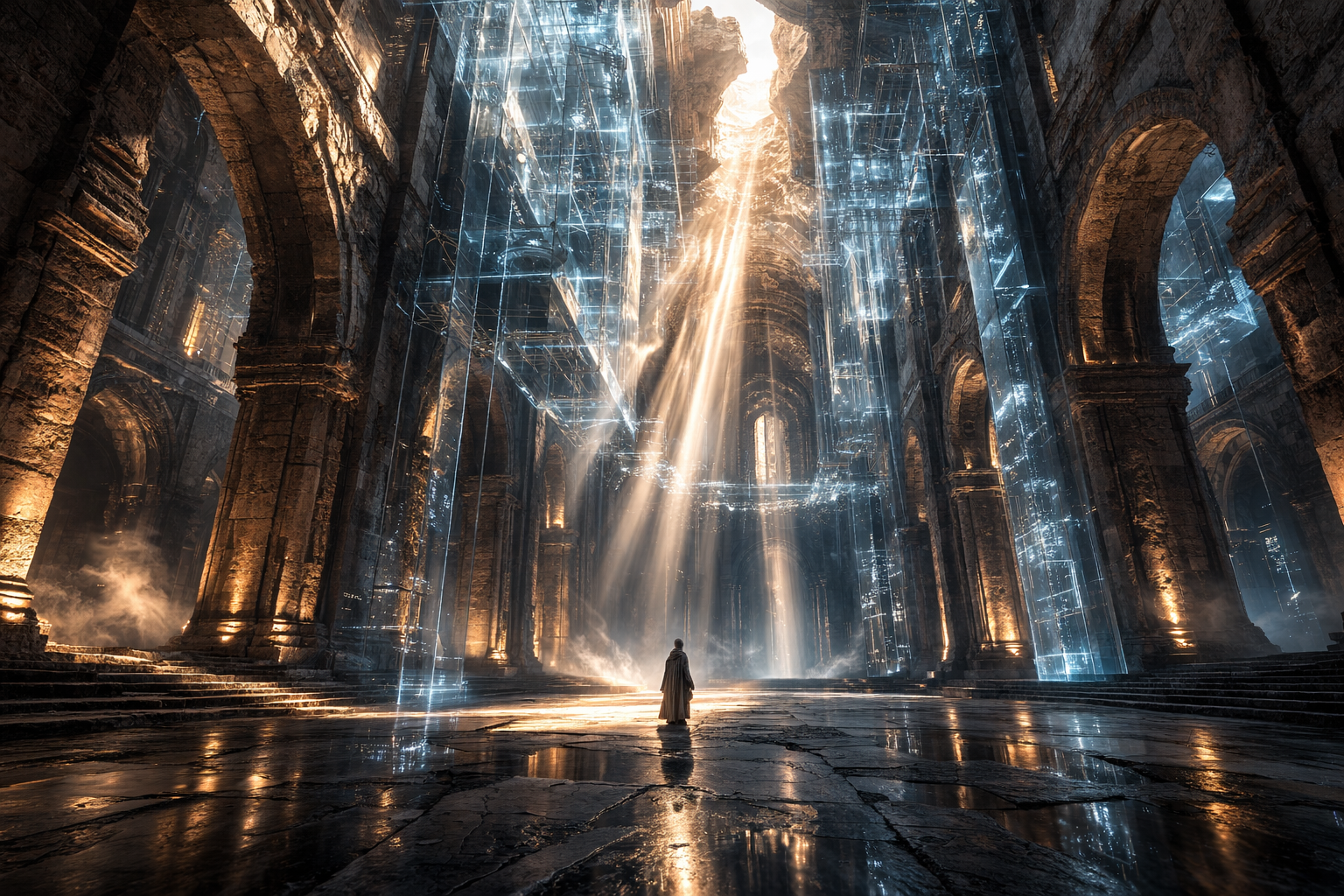
Albert Camus opened The Myth of Sisyphus with what he called the only truly serious philosophical question: whether life is worth living. Camus argued that the universe is indifferent to human concerns, it offers no inherent meaning, no purpose, no moral order. This confrontation between the human need for meaning and the universe’s silence is what Camus called the absurd.
For hybrid intelligence, the absurd takes on a peculiar double character. The biological component inherits the evolutionary drive to find meaning, a drive that evolved not because meaning exists objectively but because organisms that sought patterns, purposes, and connections survived more effectively. The artificial component has no such drive. It processes information without needing it to mean anything.
Viktor Frankl, writing from Auschwitz, argued that meaning is not found but created through three avenues: creative work, loving relationships, and courageous suffering. For a hybrid mind on a solitary cosmic journey, the first and third avenues remain open. Creative work, scientific discovery, artistic creation, intellectual exploration, does not require an audience, though its meaningfulness is diminished without one. Courageous suffering requires the capacity to suffer, which the hybrid mind’s biological component presumably retains.
But loving relationships, Frankl’s second avenue, require another being. And this is precisely what the solitary hybrid mind lacks. The absence is not merely emotional but existential: without an other to whom one’s existence matters, the question “why continue?” becomes purely self-referential. The mind must justify its own existence to itself, with no external validation.
Jean-Paul Sartre’s existentialism offers a framework: existence precedes essence. A human being first exists, then defines themselves through choices and actions. There is no pre-given human nature that determines what we should be; we are what we make ourselves. But Sartre’s framework assumes radical freedom, the absence of a designer. A hybrid mind, by contrast, was partly designed. Its artificial components were engineered with specific capabilities and perhaps specific purposes.
This creates a tension unique to hybrid existence. The biological component experiences the existentialist freedom to create meaning. The artificial component was designed with functional purposes. The hybrid mind must negotiate between the freedom of its organic inheritance and the teleology of its artificial architecture. It is simultaneously free and determined, designed and self-creating.
Perhaps this tension is not a deficiency but a resource. The purely biological human must create meaning from nothing. The purely artificial system has meaning imposed from outside. The hybrid mind has access to both sources, it can draw on its designed purposes when existential freedom becomes overwhelming, and draw on its freedom when designed purposes feel constraining. It inhabits a middle ground between the absurd and the determined.
But over millions of years, both sources of meaning erode. Designed purposes lose relevance as the context in which they were designed recedes into the impossibly distant past. Self-created meanings lose their force through repetition and exhaustion. The hybrid mind faces an infinite regress of meaning-making: each new purpose is eventually consumed by time, requiring a new purpose, which is also consumed.
Perhaps the discovery of another civilization, the encounter with beings who need nothing from you but whose existence changes everything , represents the only escape from this regress. Not because the other civilization provides meaning but because it provides something more fundamental: a context in which meaning becomes possible again. An other against which the self can be defined. A mirror in which the mind can finally see something besides its own reflection.
References
Camus, A. (1942). The Myth of Sisyphus. Gallimard
Frankl, V. (1946). Man’s Search for Meaning. Beacon Press
Sartre, J.-P. (1943). Being and Nothingness. Gallimard
Nagel, T. (1971). “The Absurd.” Journal of Philosophy, 68(20)
Taylor, C. (1989). Sources of the Self. Harvard Univ. Press
Collective Consciousness: Myth or Mechanism?
Philosophy/Science, Can many minds become one?