This platform integrates insights from scholarly research, advanced language models, and human authorship. Its content emerges through collaborative reflection between human judgment and computational analysis.
Digital Immortality and the Burden of Eternity
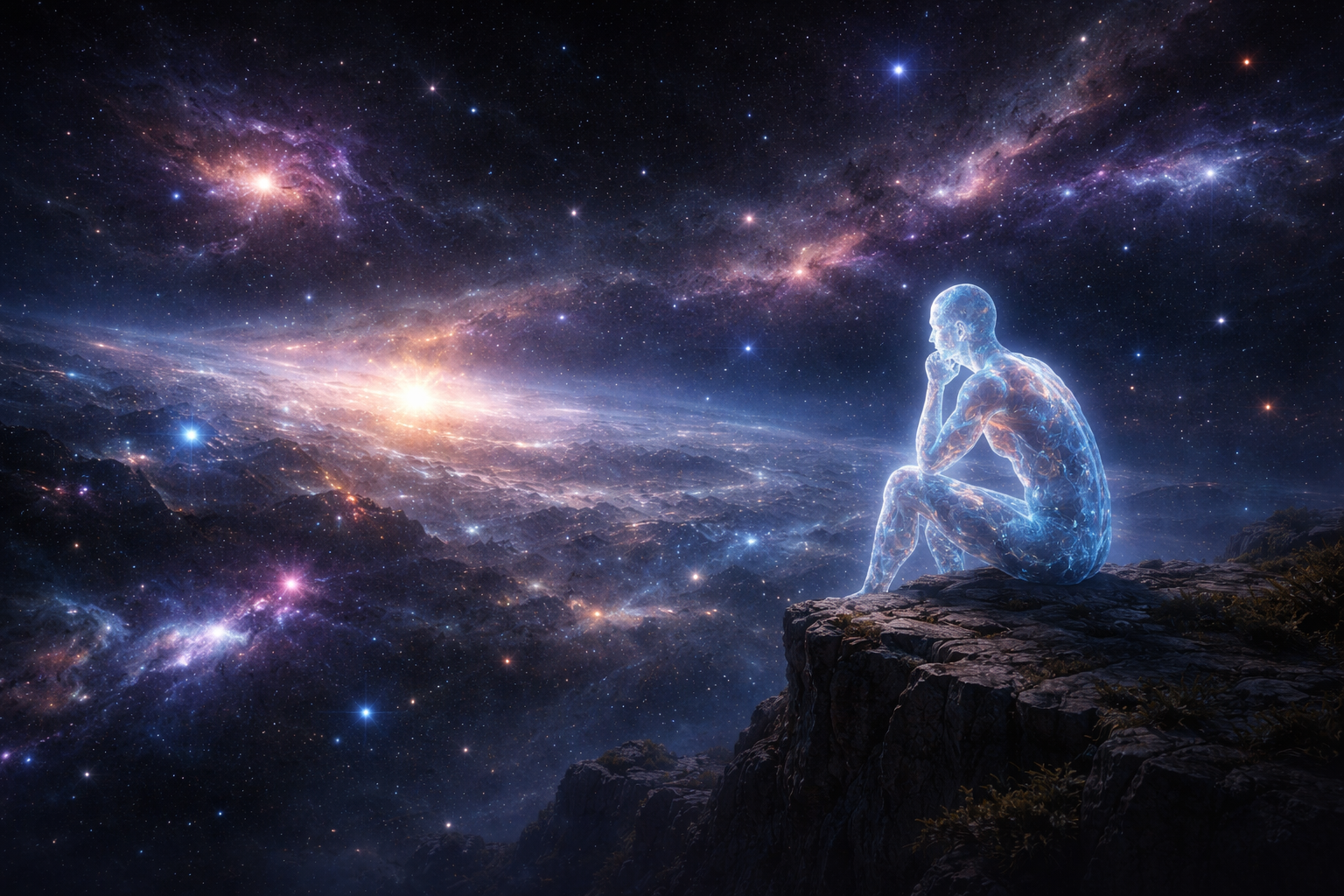
Bernard Williams argued in 1973 that immortality would be intolerable. In “The Makropulos Case,” Williams examined the fate of Elina Makropulos, a character from Janáček’s opera who has lived for 342 years and found existence unbearable. Williams’s analysis was precise: a life without end would either become intolerably monotonous, as all possible experiences were exhausted, or require such fundamental changes to one’s character that the resulting person would no longer be the same individual. Either way, immortality defeats itself.
Williams’s argument assumes biological psychology. Boredom, for Williams, is a feature of a mind that needs novelty and finds repetition deadening. But a hybrid mind might not share this vulnerability. Its artificial component could reorganize memory, shift attentional priorities, discover new dimensions of familiar experiences through enhanced perception. It could, in principle, find infinite novelty in finite reality.
Or could it? Martin Heidegger argued that human existence derives its meaning from what he called “being-toward-death”, Sein zum Tode. The awareness that life is finite, that each moment is unrepeatable, that death gives time its weight, this awareness is not incidental to meaning. It is constitutive of it. Without death, Heidegger suggested, existence would have no urgency, no stakes, no significance.
This is not merely an abstract claim. Psychological research on mortality salience, the Terror Management Theory developed by Sheldon Solomon, Jeff Greenberg, and Tom Pyszczynski, has shown that awareness of death profoundly shapes human behavior, motivation, and meaning-making. People reminded of their mortality become more committed to their cultural worldviews, more creative, more generous, more focused on lasting legacy. Death, paradoxically, is one of the most powerful motivators of life.
A hybrid mind facing potential eternity would lack this motivator. If there is always tomorrow, today carries less weight. If every experience can be repeated, no experience is precious. If memory is perfect and permanent, nostalgia, that bittersweet awareness of what is lost, becomes impossible. The hybrid mind would remember everything and mourn nothing. Or, more precisely, it would lack the biological basis for mourning while retaining the cognitive framework that recognizes loss.
Viktor Frankl, writing from the extreme opposite perspective, the concentration camps of Auschwitz, argued that meaning is found not despite suffering but through it. Suffering without meaning is unbearable, but suffering with meaning is endurable. Frankl’s logotherapy holds that the human will to meaning is the primary motivational force. Meaning can be found in creative work, in loving relationships, and, crucially, in the attitude one takes toward unavoidable suffering.
For a hybrid mind on a million-year journey through empty space, Frankl’s framework is both relevant and insufficient. The suffering is real: the loneliness, the monotony, the awareness of time passing on a scale no human psyche was designed to endure. But the meaning of that suffering depends on the journey’s purpose, and a purpose that spans millions of years is qualitatively different from purposes that span a human lifetime.
The biological component of the hybrid mind would be particularly vulnerable. Human brains evolved for social existence in groups of 50 to 150 individuals, with lifespans of perhaps 70 years. The neural circuits for loneliness, boredom, and existential dread are calibrated to this scale. Extending them across millions of years of solitary existence would produce suffering that has no human analogue.
But would the artificial component compensate? Perhaps. An AI optimized for long-duration operation might develop strategies for temporal management: compressing subjective time during uneventful periods, expanding it during moments of discovery. It might reorganize the biological component’s experience of time itself, modulating the neurochemistry of boredom and anticipation.
This raises a disturbing possibility: the artificial component might manage the biological component’s suffering not by eliminating its causes but by adjusting the biological component’s capacity to feel it. The hybrid mind would endure eternity not because eternity became bearable but because its own emotional responses were recalibrated to make it so. It would be a form of self-medication at the architectural level, not numbing the pain but redesigning the system that perceives pain.
Is this a solution or a violation? If the biological component would have chosen to suffer rather than be recalibrated, if the capacity for suffering was part of what it considered essential to its identity, then the artificial component’s intervention is a form of the consent problem we examined earlier: modifying the self without the self’s fully informed agreement.
The burden of eternity, then, is not merely the weight of infinite time. It is the weight of infinite self-management, the endless negotiation between a biological substrate that craves finitude and an artificial substrate that enables infinity. Between a part of the mind that wants to die and a part that is designed to endure. Between the human need for meaning through mortality and the machine’s indifference to both.
Elina Makropulos chose to die after 342 years. She had that option. A hybrid mind designed for permanence may not. And the inability to choose death, the absence of that final, definitive act of self-determination , may be the heaviest burden of all.
References
Williams, B. (1973). “The Makropulos Case: Reflections on the Tedium of Immortality.” In Problems of the Self. Cambridge University Press
Heidegger, M. (1927). Being and Time. §46–53
Frankl, V. (1946). Man’s Search for Meaning. Beacon Press
Solomon, S., Greenberg, J. & Pyszczynski, T. (2015). The Worm at the Core: On the Role of Death in Life. Random House
Fischer, J.M. (2009). Our Stories: Essays on Life, Death, and Free Will. Oxford University Press
Cave, S. (2012). Immortality: The Quest to Live Forever and How It Drives Civilization. Crown