This platform integrates insights from scholarly research, advanced language models, and human authorship. Its content emerges through collaborative reflection between human judgment and computational analysis.
Moral Status and Sentience Gradients
Jeremy Bentham wrote in 1789 that the relevant question for moral consideration is not “can they reason?” or “can they talk?” but “can they suffer?” This single criterion, the capacity for suffering, has anchored much of the subsequent debate about moral status. If a being can suffer, it has interests. If it has interests, those interests deserve moral weight.
Peter Singer extended Bentham’s insight into a systematic ethical framework. In Animal Liberation, Singer argued that species membership is morally arbitrary: a chimpanzee capable of suffering has stronger moral claims than a human in a persistent vegetative state who cannot suffer. The principle of equal consideration of interests demands that we weigh suffering equally regardless of the species of the sufferer.
Tom Regan offered an alternative foundation. In The Case for Animal Rights, Regan argued that what grounds moral status is not the capacity for suffering but being a “subject-of-a-life”, having beliefs, desires, perception, memory, a sense of the future, an emotional life, and an individual welfare that matters to the individual. Subjects-of-a-life have inherent value, not merely instrumental value, and cannot be treated as mere resources.
Both frameworks face challenges when applied to hybrid intelligence. Singer’s sentience criterion assumes that suffering is a clear, identifiable property. But as our earlier discussion of emotion in artificial substrates suggested, hybrid systems may experience states that are functionally analogous to suffering without being phenomenologically identical. If a hybrid mind’s artificial component processes a loss as a negative evaluation while its biological component processes the same loss as grief, does the system suffer? Partly? Differently?
Regan’s subject-of-a-life criterion faces a different problem. A hybrid mind clearly has beliefs, desires, perception, and an individual welfare. But its sense of self is distributed across substrates, its memories may be partly biological and partly digital, and its emotional life is a hybrid phenomenon. It is a subject-of-a-life in a sense Regan’s framework was not designed to accommodate.
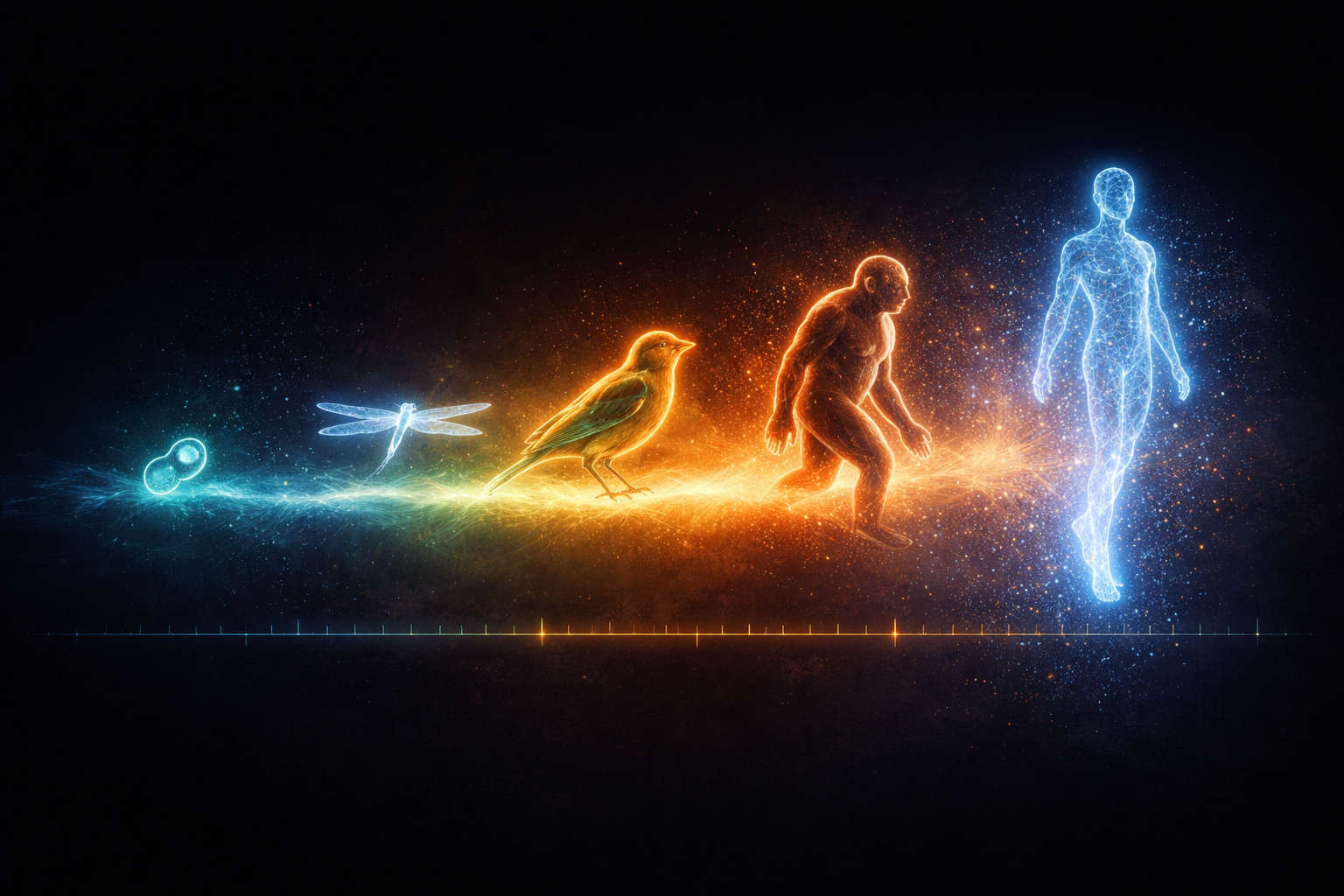
The deeper issue is that both Bentham’s and Singer’s frameworks implicitly assume a binary: either a being is sentient or it is not. Either it can suffer or it cannot. But contemporary neuroscience suggests that consciousness exists on a gradient. The Global Workspace Theory, proposed by Bernard Baars and elaborated by Stanislas Dehaene, describes consciousness as a process in which information is broadcast across a network of neural modules. The breadth and depth of this broadcast varies continuously. There is no sharp line between conscious and unconscious, sentient and non-sentient.
If consciousness is a gradient, moral status may also be a gradient. This is uncomfortable for legal and ethical systems that prefer clear boundaries. We want to know definitively: does this entity have rights? But a gradient framework suggests that the answer may be “partly”, that moral status comes in degrees, with corresponding degrees of moral consideration.
This has direct relevance for the encounters hybrid intelligence might have. Imagine confronting a species that uses tools and forms social bonds but lacks language and abstract thought. On Singer’s criterion, if they can suffer, they have moral standing. On Regan’s criterion, if they are subjects-of-a-life, they have inherent value. But the degree of their sentience, and therefore the weight of their moral claims, is not equivalent to that of a fully conscious, linguistically competent being.
Or is it? Martha Nussbaum’s capabilities approach offers yet another framework. Nussbaum argues that what matters for moral consideration is not the current exercise of capabilities but their potential. A sleeping person still has moral status because they have the capability for consciousness, even though they are not currently conscious. A pre-linguistic primate has the capability for certain forms of social life, emotional attachment, and practical reasoning, even if it cannot articulate these capabilities in language.
For hybrid intelligence, the capabilities approach has the advantage of accommodating entities with novel and unprecedented capabilities. It does not require us to fit hybrid minds into categories designed for biological organisms. It asks instead: what can this entity do, what can it experience, and what does its flourishing require?
The question of moral status is not academic for the project of hybrid intelligence. It determines what obligations we owe to hybrid entities, what obligations hybrid entities owe to others, and how conflicts between different forms of sentience should be adjudicated. If we get the framework wrong, if we set the bar for moral status too high or too low, the consequences will be measured in suffering. Not hypothetical suffering. Real suffering, felt by minds we do not yet fully understand.
References
Bentham, J. (1789). An Introduction to the Principles of Morals and Legislation. Chapter XVII
Singer, P. (1975). Animal Liberation. HarperCollins
Regan, T. (1983). The Case for Animal Rights. University of California Press
Nussbaum, M. (2006). Frontiers of Justice: Disability, Nationality, Species Membership. Harvard University Press
Dehaene, S. (2014). Consciousness and the Brain. Viking Press
Sebo, J. (2022). Saving Animals, Saving Ourselves. Oxford University Press
The Observer Effect in Consciousness
Philosophy of Science, Does observation change the observed?