This platform integrates insights from scholarly research, advanced language models, and human authorship. Its content emerges through collaborative reflection between human judgment and computational analysis.
The Architecture of Hybrid Systems
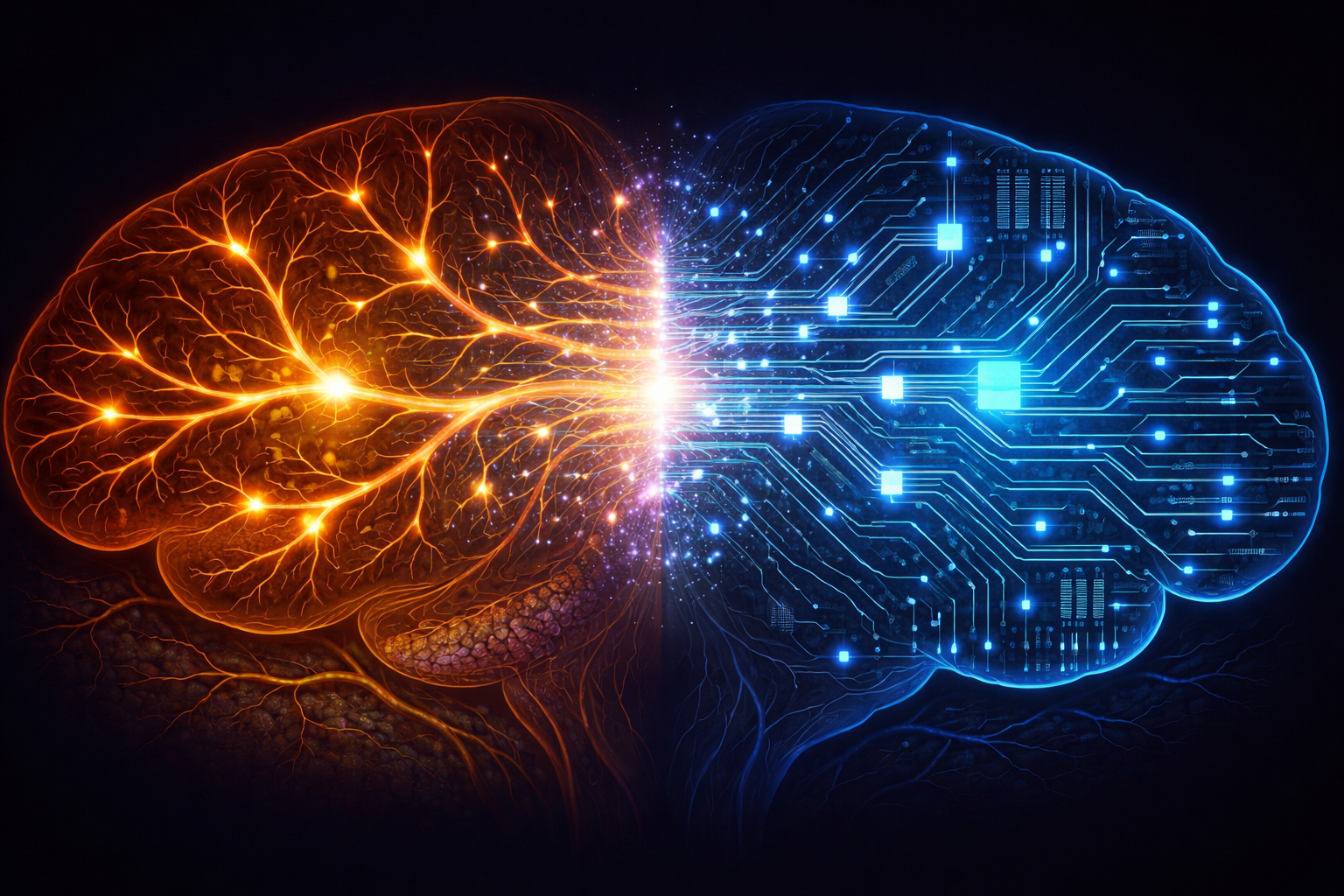
Intelligence has always been substrate-dependent. Neurons propagate signals through electrochemical cascades operating at roughly 120 meters per second. Transistors switch states through electrical fields at nearly the speed of light. These are not merely different speeds; they represent fundamentally different computational paradigms. And yet the emerging discipline of hybrid architecture insists that these paradigms can be made to converge.
The most tangible expression of this convergence is the brain-computer interface. But to call a BCI a “bridge” between brain and machine is to misunderstand its nature. A bridge connects two separate landmasses. What a mature BCI creates is something closer to a new terrain, a computational landscape that is neither fully neural nor fully digital.
Consider the trajectory of intracortical BCIs. The Utah array, developed at the University of Utah in the 1990s, consists of 96 silicon microelectrodes implanted directly into the cerebral cortex. Each electrode records the electrical activity of nearby neurons. Early systems could decode simple motor intentions, move left, move right, with modest accuracy. But the BrainGate consortium, building on this foundation, demonstrated something more profound: over weeks of use, patients’ cortical neurons reorganized their firing patterns to improve communication with the decoder algorithm. The brain was not simply being read. It was learning to speak a new language.
This bidirectional adaptation is the key architectural principle of hybrid systems. It is not enough for the machine to interpret the brain. The brain must also reshape itself to optimize the interface. And the machine must respond to that reshaping. The result is a coupled dynamical system, what control theorists call a “co-adaptive loop.” Neither component is static. Neither is dominant. Both are perpetually adjusting to each other.
The neuromorphic chip represents a parallel approach to convergence. Intel’s Loihi 2 processor, released in 2021, contains over one million artificial neurons that communicate through spikes, discrete electrical pulses that mimic biological action potentials. Unlike conventional processors that operate on clock cycles, neuromorphic chips are event-driven: they compute only when stimulated, consuming dramatically less power. IBM’s TrueNorth chip, with 5.4 billion transistors arranged in a neurosynaptic architecture, demonstrated that silicon could replicate certain neural dynamics with remarkable fidelity.
But mimicry is not merger. A neuromorphic chip that behaves like a neuron is still fundamentally silicon. It does not grow. It does not heal. It does not adapt through the same evolutionary pressures that shaped biological neural networks over hundreds of millions of years. True hybrid architecture requires something more radical: bidirectional plasticity, where organic neurons can reprogram artificial circuits while those circuits simultaneously reshape synaptic patterns.
This is no longer purely theoretical. Researchers at ETH Zurich have demonstrated living neurons grown on microelectrode arrays that form functional connections with silicon circuits. The neurons fire; the circuits respond; the response modulates the neurons’ subsequent firing. In a 2023 study published in Nature Electronics, a team at Monash University created an interface they called “DishBrain”, a culture of human neurons on a chip that learned to play the video game Pong. The neurons were not programmed. They learned through a feedback mechanism that rewarded coherent activity patterns. The system exhibited goal-directed behavior without any conventional software.
These are primitive systems. The bandwidth is low, the complexity minimal, the lifespan of the neural cultures limited. But they demonstrate a principle: biological and artificial substrates can form a single computational system that is not reducible to either component.
The engineering challenges are formidable. Biological tissue operates in a warm, wet, chemically complex environment. Silicon requires controlled, dry, electrostatically stable conditions. The interface between these environments, the so-called “biotic-abiotic junction”, is where most current systems fail. Electrode degradation, immune response, signal noise, and the sheer fragility of neural tissue all conspire against long-term stability. Elon Musk’s Neuralink has made bold claims about solving these problems, but as of the mid-2020s, the clinical reality remains far more modest than the marketing suggests.
Yet there is a deeper challenge that no amount of engineering can resolve: the question of integration versus augmentation. Current BCIs augment human capability, they give paralyzed patients the ability to move cursors or robotic arms. But augmentation preserves the boundary between human and machine. The human remains the user; the machine remains the tool. True hybrid architecture dissolves this boundary. And dissolution raises questions that engineering cannot answer.
If a system’s cognitive processes are distributed across biological and artificial substrates in a way that neither component can function independently, if removing the silicon would impair the organic, and removing the organic would cripple the silicon, then we are no longer talking about a human with a prosthetic. We are talking about a new kind of entity. An entity whose architecture is its identity.
The question, then, is not whether such systems can be built. The trajectory of BCI research, neuromorphic computing, and organoid intelligence suggests they will be. The question is whether we are prepared to recognize what they are, and what they are not.
They are not upgraded humans. They are not embodied machines. They are something for which we do not yet have a name. And naming, as any philosopher of language will tell you, is never neutral. The categories we choose will shape the rights we grant, the responsibilities we assign, and the futures we permit.
References
Hochberg, L.R. et al. (2006). “Neuronal Ensemble Control of Prosthetic Devices by a Human with Tetraplegia.” Nature, 442, 164–171
Davies, M. et al. (2021). “Advancing Neuromorphic Computing with Loihi 2.” Intel Labs White Paper
Merolla, P.A. et al. (2014). “A Million Spiking-Neuron Integrated Circuit.” Science, 345(6197), 668–673
Kagan, B.J. et al. (2022). “In Vitro Neurons Learn and Exhibit Sentience When Embodied in a Simulated Game-World.” Neuron, 110(23), 3952–3969
Musk, E. & Neuralink (2019). “An Integrated Brain-Machine Interface Platform.” Journal of Medical Internet Research, 21(10)
Clark, A. (2003). Natural-Born Cyborgs: Minds, Technologies, and the Future of Human Intelligence. Oxford University Press
Emergent Properties: When 1+1≠2
Complexity Theory, Is the whole more than the sum of its parts?