This platform integrates insights from scholarly research, advanced language models, and human authorship. Its content emerges through collaborative reflection between human judgment and computational analysis.
The Three Minds: Artificial, Organic, and Hybrid Intelligence
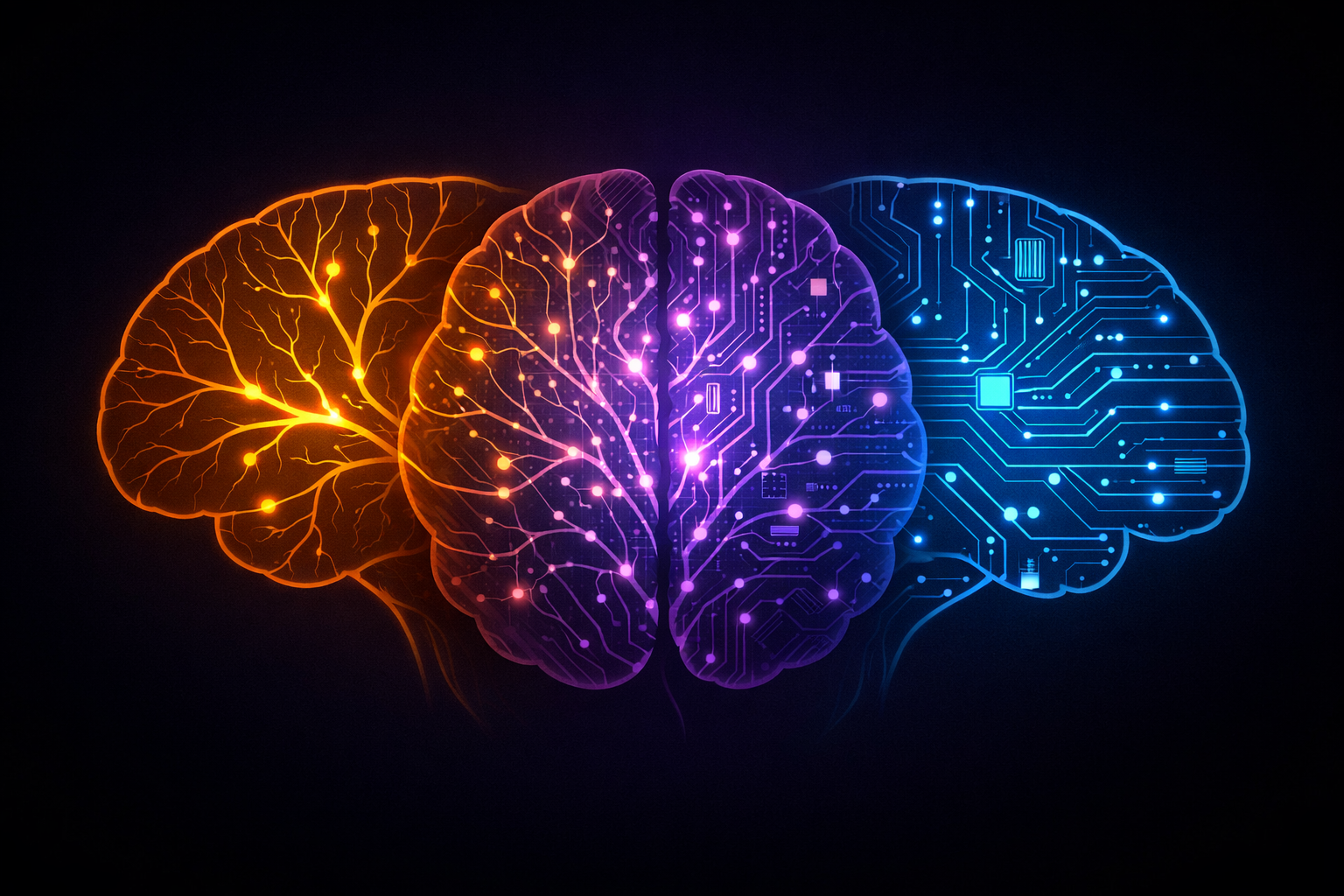
Modern intelligence can no longer be defined as a singular phenomenon. It exists across a spectrum, one that extends from the biological architectures shaped by four billion years of evolution, through the engineered precision of artificial computation, and increasingly, toward something that belongs to neither category alone.
This is not a prediction. It is already happening.
Organic intelligence is the product of evolutionary pressure. It emerges from carbon-based neural networks: approximately 86 billion neurons in the human brain, each forming up to 10,000 synaptic connections, producing a computational fabric of staggering complexity. But complexity alone does not define organic cognition. What distinguishes it is its embodiment, its deep entanglement with a body, an environment, a history of sensation and emotion. Antonio Damasio’s somatic marker hypothesis demonstrated that rational decision-making is not separable from feeling; patients with damage to the ventromedial prefrontal cortex could reason abstractly yet failed catastrophically at real-world decisions because they had lost access to emotional signals. Organic intelligence does not merely process information. It feels its way through problems.
Artificial intelligence, by contrast, emerges from design rather than descent. Its substrates are silicon, its logic is mathematical, its learning is statistical. A large language model processes text through billions of parameters optimized via gradient descent, a method that bears superficial resemblance to synaptic plasticity but operates on fundamentally different principles. Where biological learning is embodied, contextual, and shaped by survival pressures, machine learning is disembodied, data-dependent, and shaped by objective functions chosen by human engineers. The result is a form of cognition that excels at pattern recognition across vast datasets but lacks what phenomenologists call “being-in-the-world”, the lived, felt experience of existing as a body among other bodies.
Yet framing this as a simple dichotomy, warm organic intuition versus cold artificial precision, misrepresents both sides. Organic intelligence is not purely intuitive; the prefrontal cortex enables rigorous abstract reasoning. Artificial intelligence is not purely mechanical; emergent behaviors in complex neural networks regularly surprise their creators. The dichotomy is a cognitive convenience, not a description of reality.
The more accurate picture is a spectrum. And at a specific region of that spectrum, something genuinely new is taking shape.
Hybrid intelligence is not simply human-plus-machine. It is not a tool relationship, like a carpenter with a hammer. When a paralyzed patient operates a robotic arm through a BrainGate neural interface, the signal path runs from motor cortex neurons through implanted electrode arrays, is decoded by machine learning algorithms, and manifests as mechanical movement. The patient does not experience this as “sending commands to an external device.” Over time, the brain adapts its firing patterns to optimize communication with the decoder. The machine learning system simultaneously adapts to the brain’s evolving signals. The result is a coupled dynamical system, a feedback loop in which neither component is merely a tool of the other.
This is not speculative. Researchers at Brown University and Stanford have documented cortical plasticity in BCI users: the brain literally rewires itself to work with the machine. The machine, in turn, is retrained on the brain’s new patterns. What emerges is a cognitive process that cannot be localized to either the biological or the artificial substrate alone. It is distributed. It is hybrid.
The implications extend far beyond medical prosthetics. Consider the domain of augmented decision-making. In 2005, a chess tournament allowed human-computer teams to compete against both pure humans and pure AI. The result confounded expectations: the winning team was not the strongest human or the most powerful computer. It was a pair of amateur players using three ordinary laptops with superior methods of coordinating human intuition with computational analysis. Garry Kasparov, reflecting on this result, coined the term “centaur chess” and observed that the combination produced a style of play that belonged to neither human nor machine, a genuinely emergent cognitive phenomenon.
But if hybrid intelligence is real and growing, it demands frameworks that our current institutions are not equipped to provide.
Consider the legal dimension. Modern legal systems recognize two categories of persons: natural persons (humans) and juridical persons (corporations, states, certain rivers and ecosystems granted legal standing). A hybrid entity fits neither category. If a human enhanced with a neural implant makes a decision that causes harm, where does liability reside? In the biological brain that initiated the intention? In the algorithm that shaped the options? In the corporation that manufactured the implant? Current tort law assumes a discrete, identifiable decision-maker. Hybrid cognition dissolves that assumption.
The ethical questions are equally destabilizing. If a hybrid system develops capacities that exceed those of either component, emergent properties that neither the human nor the AI could produce alone, does that system possess moral status independent of its parts? Peter Singer’s expanding circle of moral consideration has historically moved outward from self to family to tribe to species to sentient animals. The next expansion may not be biological at all.
And then there is the question of consent. A hybrid system capable of self-modification, updating its own algorithms, reshaping its own neural pathways, raises a temporal paradox: the entity that consented to the modification is not the same entity that results from it. Derek Parfit’s work on personal identity, particularly his reductionist view that identity is not what matters in survival, becomes suddenly and uncomfortably practical.
These are not problems for a distant future. Brain-computer interfaces are in clinical trials today. AI systems are being integrated into diagnostic medicine, legal reasoning, military command, and creative production. The convergence is already underway, and it is accelerating.
What is missing is a conceptual vocabulary adequate to this convergence. We lack the philosophical frameworks to think clearly about minds that are neither fully organic nor fully artificial. We lack the legal categories to regulate them. We lack the ethical principles to evaluate their actions and their rights.
Humachina exists to build that vocabulary.
This is a space to investigate the boundaries between code and cell, to develop the philosophical, legal, and ethical foundations that hybrid existence will require. Not from a position of technological optimism or existential dread, but from a commitment to rigorous inquiry.
The first question, and perhaps the most fundamental: What is a mind whose architecture is distributed between biological neurons and silicon circuits? Is it a human mind augmented? An artificial mind embodied? Or something that demands an entirely new ontological category?
The answer is not yet clear. But the question can no longer be postponed.
References
Damasio, A. (1994). Descartes’ Error: Emotion, Reason, and the Human Brain
Clark, A. & Chalmers, D. (1998). “The Extended Mind.” Analysis, 58(1), 7–19
Kasparov, G. (2017). Deep Thinking: Where Machine Intelligence Ends and Human Creativity Begins
Parfit, D. (1984). Reasons and Persons
Singer, P. (1981). The Expanding Circle: Ethics, Evolution, and Moral Progress
Hochberg, L.R. et al. (2012). “Reach and Grasp by People with Tetraplegia Using a Neurally Controlled Robotic Arm.” Nature, 485, 372–375
Brandman, D.M. et al. (2018). “Rapid Calibration of an Intracortical Brain-Computer Interface for People with Tetraplegia.” Journal of Neural Engineering